251. St. Augustine vs. Nietzsche on Evil
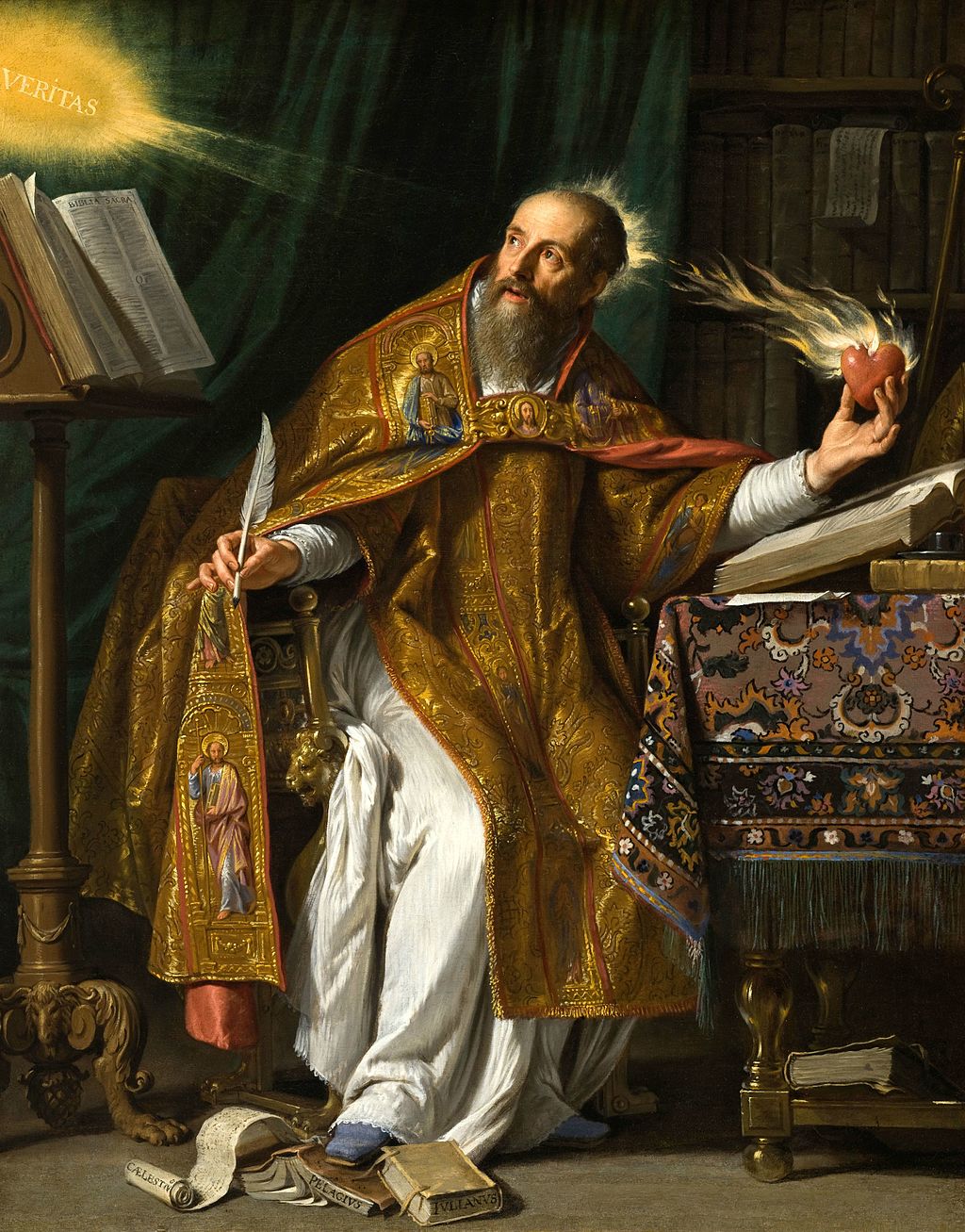
St. Augustine (354-430) famously put forth the privation theory of evil. Consider this passage:
“For what is that which we call evil but the absence of good? In the bodies of animals, disease and wounds mean nothing but the absence of health; for when a cure is effected, that does not mean that the evils which were present – namely, the diseases and wounds – go away from the body and dwell elsewhere: they altogether cease to exist; for the wound or disease is not a substance, but a defect in the fleshly substance – the flesh itself being a substance, and therefore something good, of which those evils – that is, privations of the good which we call health – are accidents. Just in the same way, what are called vices in the soul are nothing but privations of natural good. And when they are not transferred elsewhere: when they cease to exist in the healthy soul, they cannot exist anywhere else.” See The Essential Augustine (Hackett, 1974), p. 65.
Here we see Augustine claiming that evil is a privation or an absence of some “natural good” that should be present for some particular being. For example, a stone’s inability to see isn’t an evil since a stone, by nature, can’t see. But blindness in a cat or a human would be an evil since a properly functioning cat or human should, by nature, have the good of sight. Since privations are not substances or things since they can’t, as Augustine says, exist on their own: they are only intelligible with reference to the things that are deprived. Thus we don’t think of blindness as a substance that exists on its own independent of an eye.
Of course, the evil of blindness is a natural, rather than a moral, evil insofar as it is not connected to freedom and responsibility. But suppose one has a privation of courage and is a coward. Then, based on this privation, one might freely decide to tell a slanderous lie in order to avoid a conflict which a courageous person would face. Thus we would have a privation of courage that, when aligned with free will, led to immoral action. Of course, we might be inclined to label this act of lying as bad rather than evil. However, suppose we have someone with a set of privations that make it difficult for him to enter into consensual sexual relations with others. But rather than working on overcoming these vices he freely chooses to rape someone and, in doing so, introduces various physical and psychological privations in the victim. Then we would have an evil act due to, among other things, the extreme harm caused. So we can distinguish bad from evil with a careful analysis of the nature of the privations as far as motives, acts, and consequences are concerned. But whatever the case may be, the badness and evil will have to be understood with reference to what should, by nature, be present.
This is a very influential yet controversial theory of evil (see the link below to my three-post series that explores it in more detail and offers a defense). You often come across philosophers who disagree with it and, indeed, it is often left out of contemporary discussions about the nature of evil all together. What you do not come across very often is the view which Friedrich Nietzsche (1844-1900) periodically explores in his book The Gay Science (and elsewhere in his work). This is the disturbing view that goodness is actually a privation of evil:
“Where Goodness Begins. Where bad eyesight can no longer see the evil impulse as such, on account of its refinement, there man sets up the kingdom of goodness; and the feeling of having now gone over into the kingdom of goodness brings all those impulses (such as the feelings of security, of comfortableness, of benevolence) into simultaneous activity, which were threatened and confined by the evil impulses. Consequently, the duller the eye so much the further does goodness extend! Hence the eternal cheerfulness of the populace and of children! Hence the gloominess and grief (allied to the bad conscience) of great thinkers.” (see section 53; translated by Thomas Common).
Here we have a reversal of the privation theory of evil. Rather than evil as an absence of a natural good, we have goodness as an absence of a natural evil. The “kingdom of goodness” emerges only when evil impulses are not seen and become deficient in some way.
Initially, this view that evil is substantial and goodness a privation appears to be incoherent since evil is traditionally understood as unstable, discontinuous, irrational, and destructive of life, flourishing, love, community, and so on. In his book Beyond the Pleasure Principle (1920), Freud discusses his concept of the death instinct and notes that in Goethe’s Faust Mephistopheles offers an “exceptionally convincing identification of the principle of evil with the destructive instinct” and quotes a few lines:
For all things, from the Void
Called forth, deserve to be destroyed…
Thus, all which you as Sin have rated—
Destruction,—aught with Evil blent,—
That is my proper element.
He also notes that “The Devil himself names as his adversary, not what is holy and good, but Nature’s power to create, to multiply life—that is, Eros” and quotes these lines:
From Water, Earth, and Air unfolding,
A thousand germs break forth and grow,
In dry, and wet, and warm, and chilly:
And had I not the Flame reserved, why, really
There’s nothing special of my own to show.
(all lines from Part I, Scene 3; translated by Bayard Taylor)
Surely Goethe’s vision of evil as essentially destructive and antagonistic to life makes good sense and does justice to both the facts of our experience and the use of the term ‘evil.’ If so, it is hard to see how evil could be the substantial ground whose privations are forms of goodness. Indeed, it would seem that life wouldn’t get very far at all if we were primarily constituted by “evil impulses.”
But Nietzsche claims evil is indeed our nourishing ground. In section 371 he claims we “unintelligible ones” breaking with traditional morality “thrust our roots always more powerfully into the deep—into evil—while at the same time we embrace the heavens ever more lovingly, more extensively, and suck in their light ever more eagerly with all our branches and leaves. We grow like trees—that is difficult to understand, like all life!—not in one place, but everywhere, not in one direction only, but upwards and outwards, as well as inwards and downwards.” In section 225 he points out that, while great men have often reasoned “Nature is evil! Let us therefore be natural!,” preachers of morality have lied about evil people being miserable when, in fact, “they were only too well aware of the overflowing happiness of this kind of man, but they kept silent as death about it; because it was a refutation of their theory, according to which happiness only originates through the annihilation of the passions and the silencing of the will!” (section 326). And it isn’t just that evil people are happy. For “even the most hurtful man is still perhaps, in respect to the conservation of the race, the most useful of all; for he conserves in himself, or by his effect on others, impulses without which mankind might long ago have languished or decayed. Hatred, delight in mischief, rapacity and ambition, and whatever else is called evil—belong to the marvellous economy of the conservation of the race; to be sure a costly, lavish, and on the whole very foolish economy:—which has, however, hitherto preserved our race, as is demonstrated to us (section 1). We simply don’t realize, due to the naive shortsightedness of goodness, that “all “evil” instincts were subordinated to knowledge, were placed in its service, and acquired the prestige of the permitted” (section 110). So according to Nietzsche evil can, contrary to our received views and intuitions, be the ground for stability, knowledge, life, preservation, growth, happiness, and so on.
Perhaps this is a semantic debate in which we have two terms, ‘good’ and ‘evil,’ which are actually referring to the same thing in different ways. But, assuming we really have two different philosophical visions of evil on the table, let’s ask: is one of these views more intuitive and/or rationally defensible than the other? If so, why?

For my three-post series on the privation theory of evil, go here.
For my many posts on evil, go here.
For my various posts on Nietzsche, go here.
For my post on St. Augustine’s notion of the divine illumination, go here.
For my post on Augustine’s argument for God’s existence, go here.