267. A Cartesian hope that we aren’t inescapably caught in a simulation
I often come across concerns on social media and elsewhere that we may be living in a simulation generated by a malevolent being of some kind. I recently had a conversation in which someone claimed such a being may be so powerful, indeed all powerful, making our chances of detecting and escaping our simulated predicament zero. This is a troubling thought and, while I don’t have a knock down argument against it, some ideas came to mind from the French philosopher and polymath René Descartes (1596-1650) that offer some hope.
In his classic work Meditations on First Philosophy (1641) Descartes employs a method he invented, which has come to be called the method of doubt, in order to find an absolutely certain proposition (or a proposition beyond rational doubt, that is, a doubt that doesn’t entail a contradiction). This method states that if one can rationally doubt a proposition then it will be considered false. The hope is that anything which can survive this extreme method will be certain. The most memorable application of the method comes in the beginning of Meditation Two when he applies the method to his own doubting and, in doing so, realizes that the proposition “I am, I exist” is certain every time he utters it. After all, he cannot doubt if doesn’t exist. So Descartes has found something quite remarkable: a proposition which is proven in the very act of doubting it.
But another memorable application of the method comes in Meditation One and is known as the evil demon hypothesis. This hypothesis is used to raise a rational doubt about the apparent certainty of mathematics. He argues that it is possible there is an all powerful yet evil being that could make it seem that 2+2=4 when it really equals 5. And, being evil, this being would deceive us in this fashion. This scenario is, of course, implausible. But it appears to be non-contradictory and thus possible. And this possibility is all he needs to successfully apply the method of doubt and conclude that mathematical propositions, even seemingly self-evident ones like 2+2=4, are false.
Now, if such a powerful evil demon can deceive us about basic mathematics then presumably it can deceive us about the rest of the world as well. Consider this chilling passage from the end of Meditation One (translated by Charles S. Taylor and David B. Manley):
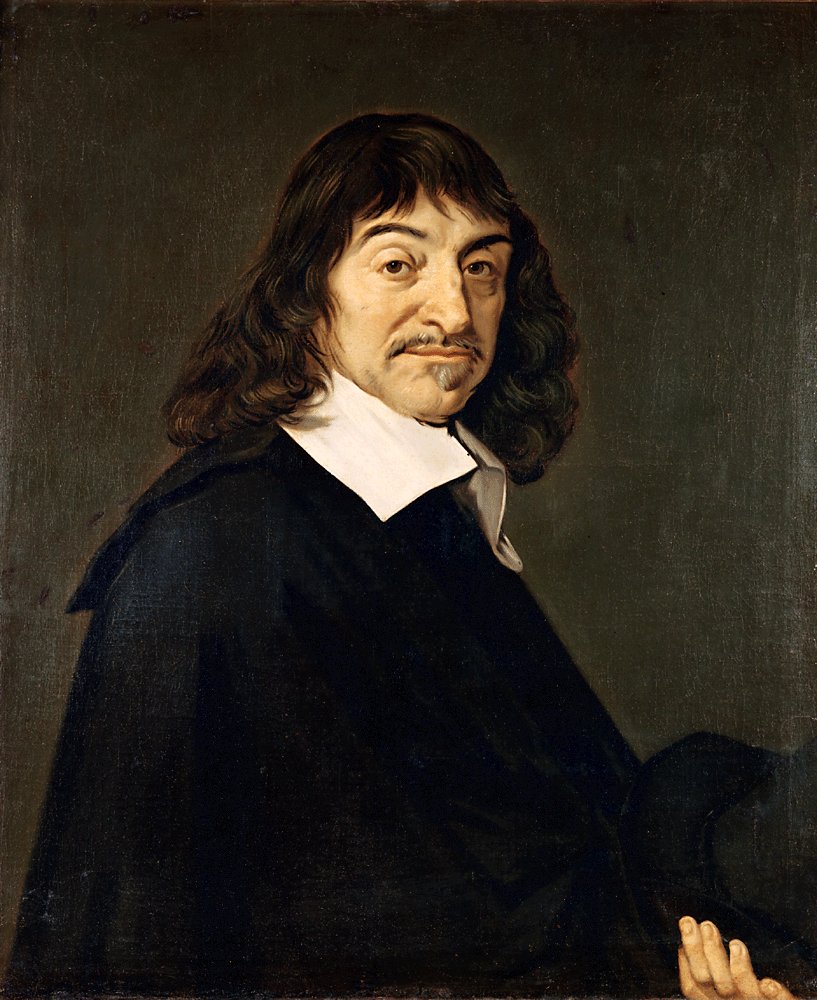
Descartes
“I will suppose, then, not that Deity, who is sovereignly good and the fountain of truth, but that some malignant demon, who is at once exceedingly potent and deceitful, has employed all his artifice to deceive me; I will suppose that the sky, the air, the earth, colors, figures, sounds, and all external things, are nothing better than the illusions of dreams, by means of which this being has laid snares for my credulity; I will consider myself as without hands, eyes, flesh, blood, or any of the senses, and as falsely believing that I am possessed of these; I will continue resolutely fixed in this belief, and if indeed by this means it be not in my power to arrive at the knowledge of truth, I shall at least do what is in my power, viz, [suspend my judgment], and guard with settled purpose against giving my assent to what is false, and being imposed upon by this deceiver, whatever be his power and artifice. But this undertaking is arduous, and a certain indolence insensibly leads me back to my ordinary course of life; and just as the captive, who, perchance, was enjoying in his dreams an imaginary liberty, when he begins to suspect that it is but a vision, dreads awakening, and conspires with the agreeable illusions that the deception may be prolonged; so I, of my own accord, fall back into the train of my former beliefs, and fear to arouse myself from my slumber, lest the time of laborious wakefulness that would succeed this quiet rest, in place of bringing any light of day, should prove inadequate to dispel the darkness that will arise from the difficulties that have now been raised.”
This demonic doubt justifies the worry that we may be living in a simulation controlled by a malevolent being. However, at the end of Meditation Three, after he has made an effort to prove God’s existence in order to recuperate the reality of both his sense experience and mathematics (God wouldn’t deceive us about these things!), he observes that “it is sufficiently manifest that God cannot be a deceiver, since it is a dictate of the natural light that all fraud and deception spring from some defect.” And early in the Meditation Four he writes: “For, in the first place, I discover that it is impossible for him ever to deceive me, for in all fraud and deceit there is a certain imperfection: and although it may seem that the ability to deceive is a mark of subtlety or power, yet the will testifies without doubt of malice and weakness; and such, accordingly, cannot be found in God.”
Here we see that Descartes subscribes to the privation theory of evil which holds that evil is a privation or a lack of of a good which, by nature, should be present. And this theory allows him to deduce that the evil demon, while perhaps very powerful, cannot be all powerful. After all, we can easily imagine a being greater than one that is deceptive since deception must, according to him, come from an imperfect source that lacks certain virtues.
This is good news for those who worry about being inescapably caught in a simulation by a malevolent being. For any such being can’t, due to its imperfection, be infallible – it will be capable of making mistakes – and if that’s the case then we have a hope of seeing through its machinations. To say there is no hope appears to be incoherent since this would imply something Descartes thinks is impossible, namely, a perfect yet deceptive being. And to this we can add two other things from Meditations: (1) we can be certain of our own existence as thinking beings (Meditation One) and (2) genuine doubting proves the existence of our free will (Meditation Four). These additions give us the free and rational agency we need if we hope to take advantage of our deceiver’s fallibility and escape from the matrix!
For my three-post series on the privation theory of evil, go here.
For my post on Descartes’ dualism, go here.
For my argument in defense of a kind of Cartesian substance dualism, go here.
For my posts on free will, go here.
For my argument for God’s existence, go here.