268. 9/11 and the Failure of the Imagination
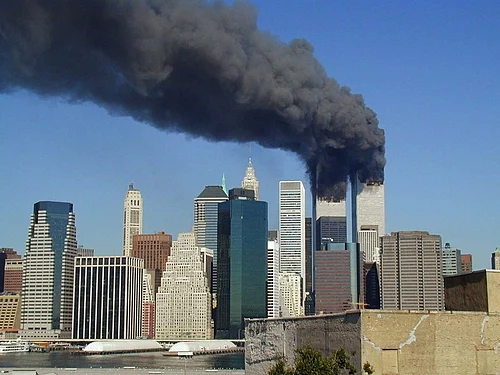
Photograph by Michael Foran
My 9/11
It sure seemed like a usual Tuesday morning. I had breakfast in my Jersey City studio apartment, walked a block to my car, and within a minute left Hamilton Park and entered the New Jersey Turnpike. The weather was nice and I was, for once, not running late to teach my 11:00 intro to philosophy class at Fairleigh Dickinson University in Madison, NJ. It was 9:45 so I figured I would arrive at 10:30 the latest.
I figured wrong. Stopped cars, many of them with people sitting on their roofs, trunks, and front hoods, brought me to a screeching halt. I noticed everyone was looking and pointing east across the Hudson River. A van to my left obscured my view, so I got out to take a look. And that’s when I saw a truly horrifying site: the upper portions of the Twin Towers ablaze and spewing massive clouds of black smoke to the south. After a few stunned moments I sought out some information from the woman to my right.
“Excuse me, do you know what happened?”
“I didn’t see it but apparently a plane crashed right into them.”
“I think it was two planes,” said a man to my left. “One plane per tower. Apparently a plane crashed into The Pentagon too.”
“What? When did all this happen?” I asked.
“Ah, the Towers were hit within the last hour I guess,” he said. “But the Pentagon was hit just a few minutes ago. I heard it on the radio.”
“Do you think this is an accident?” the woman asked.
“Three crashes in an hour? Sounds pretty planned to me,” he said.
“My God, how horrible,” she said.
“Thanks for the info folks.”
I returned to the car, tuned to 1010 Wins, and listened for a few minutes to Lee Harris’ reports about the fires, airport shutdowns, and evacuations at the Pentagon, Treasury, Capital, and the Sears Tower in Chicago. A reporter then confirmed what the man had told me: within the last hour one plane had crashed into the North Tower, another into the South Tower, and yet another into the Pentagon. The questions on my mind were those being asked by everyone: how could this have happened? Was it some kind of attack? Will the fire be brought under control? What will happen to those in the Towers? Will other acts of destruction follow? My expanding mental queries were interrupted at 9:59 when I saw the South Tower suddenly collapse and disappear into billowing clouds of dark grey smoke. I gasped as my head reared back in terror.
“Oh wait…oh my God there’s a…OH MY GOD THE BUILDING FELL! Are you there? The building just fell!” exclaimed 1010 Wins reporter Joan Fleisher from the roof of her North Moore St. apartment building.
“Which…which building?” asked Harris.
“Oh my God the south building…the…the south building just crumbled from the top! Oh my God the building just fell. The entire World Trade Center on the…the south building just fell. I just saw the whole thing. Oh my God. Oh my God. I can’t see anything, the whole thing went down,” reported Fleisher to the sound of sirens wailing in the background.
A few seconds later her moving testimony was confirmed by Lee. “What Joan is saying is true…the…the…Tower has collapsed.” And he went on to add: “A situation that, ah, started bad just gets worse, and worse, and worse.”
I could barely believe my tearing eyes as they stared at the plume of destruction in the distance. Growing up in northeast New Jersey the Towers were a part of my reality—a fixture of the skyline, a geographical beacon, a seemingly permanent reality like the sun or the moon. I had visited them on a school trip, made a model of them as a child, and seen them in many of my favorite movies including Escape from New York, Trading Places, Wall Street, and Saturday Night Fever.
Now one was simply gone.
And a few minutes later it was reported that another plane, hijacked Flight 93, crashed out in Pennsylvania. It was one shocking thing after another and there was little reason to believe the chaos would stop. I wanted to stay but a call to the college confirmed that school was open. And, to be honest, I wasn’t sure I wanted to see any further developments given how shaken I was. So I followed the slow stream of cars driving on the shoulder and left the smoldering North Tower behind me in the rear view mirror. Naturally I kept listening to the radio hoping it would remain standing despite the fire. But at 10:28 it was reported that it, too, collapsed into a pile of smokey rubble. The majestic Twin Towers were now completely annihilated.

Tragedy and the Failure of the Imagination
We can and should always engage with 9/11 on an emotional level. And we certainly can and should always approach the topic with reverence for those lost in the Towers and all the first responders who heroically put themselves in harms way. But we can also think about it.
One thing worth thinking hard about, something revealed in the recollection above, is that I, along with countless others in the United States and the world, was in a state of disbelief that 9/11 happened at all. According to the The 9/11 Commission Report‘s section “Imagination” (see a link to the Report below) such disbelief was “a failure of the imagination.” In fact, along with a set of governmental failures regarding policy, capabilities, and management, the “most important failure was one of imagination. We do not believe leaders understood the gravity of the threat. The terrorist danger from bin Laden and al Qaeda was not a major topic for policy debate among the public, the media, or in the Congress. Indeed, it barely came up during the 2000 presidential campaign.”
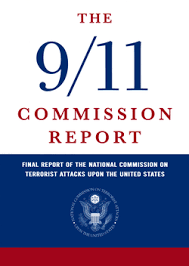
This failure was all the more disturbing given that in 1993 a van drove into the parking garage beneath the North Tower and detonated a 1,336 pound bomb which killed six people and injured over a thousand. How, given this past attack, could 9/11 happen? It was suggested by The Report and so many at the time that we just couldn’t imagine it coming. It appears our intelligence was tragically blinded in the way Oedipus was tragically blinded to the fact that he murdered his father and married his mother.
John Dewey on Imagination
In 2001 I was finally done with my Ph.D. coursework and had written two chapters of my dissertation. My topic was the role of the imagination in pragmatism or that primarily American-born philosophy which places intelligent and creative action at the center of all its philosophical concerns. I had 75 pages completed and some of it was decent. But now, given the nightmare that was unfolding, even the best passages were striking me as inadequate. I felt my work needed to respond, somehow, to 9/11. Since the notion of tragedy was in the air, and tragedy is so often connected to a failure of the imagination, I decided to switch gears and write my dissertation on tragic conflict from a pragmatic perspective and dedicate a whole chapter to 9/11. The final title ended up being The Tragic Sense of Pragmatism and I defended in 2005.
After 20 years the ideas I explored on imagination remain relevant. This is in large part because I explored them with the help of the American philosopher John Dewey (1859-1952) who both offers a novel account of imagination and connects it to creativity, art, consciousness, perception, mind, politics, and many other things. Consider this passage from his classic work Art as Experience (TarcherPerigree: 2005):
“Imagination shares with beauty the doubtful honor of being the chief theme in esthetic writings of enthusiastic ignorance. More perhaps than any other phase of human contribution, it has been treated as a special and self-contained faculty, differing from others in possession of mysterious potencies. Yet if we judge its nature from the creation of works of art, it designates a quality that animates and pervades all processes of making and observation. It is a way of seeing and feeling things as they compose an integral whole” (AE 267).
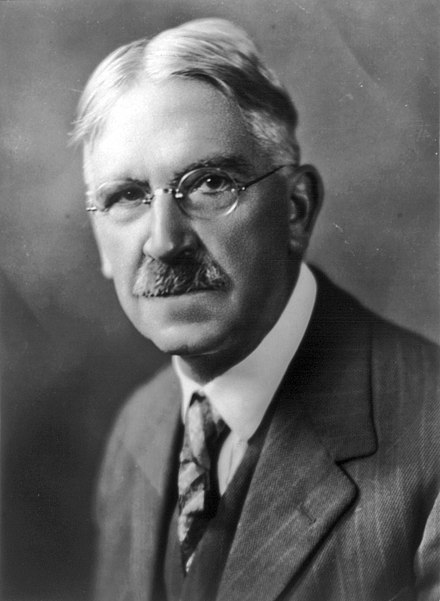
John Dewey (1859-1952)
This insight about imagination being a way of seeing and feeling things as a whole is certainly applicable to tragedy. For imagination enables us to get a sense of the bigger picture which, when it comes to tragedy, is very often exactly what people lack. As a result they can’t anticipate certain consequences and causes. Of course, rational reflection is also required to understand the world. Imaginative visions are typically not understood with imaginative visions. Nonetheless, imagination is indispensable and provides the context within which reflection occurs. In his essay “Intelligence and Evil in Human History” Dewey’s fellow pragmatist Sidney Hook (1902-1989) notes what can happen when this context shrinks: “We are all crueler than we know, not because we are evil, but because our senses and imagination have such a limited range.” He goes on: “I am speaking now of those great ranges of cruelty in modern history, involving the fate of millions, that flow from the limitations of human imagination and sensitivity, of the cruelty men do because it is easy to stand what is out of sight, and still easier to stand what is out of mind.” The ability to imagine can make us more aware of what goes on around us so we can become less inconsiderate and cruel. And it can also make us more aware of other people’s inconsideration and cruelty so we can better defend ourselves if necessary. If this is the case then the expansion of the imagination can help us avoid, or at least reduce the costs of, tragedy.
Making the Invisible Visible
Of course, it is not easy to say how imagination can be developed. I do believe that art, novels, film, philosophy, and poetry are the best means to do so. Unfortunately, the arts and humanities are currently struggling in many schools. Martha Nussbaum, in her book Not for Profit: Why Democracy Needs the Humanities, correctly observes that
“The humanities and the arts are being cut away, in both primary/secondary and college/university education, in virtually every nation of the world. Seen by policy-makers as useless frills, at a time when nations must cut away all useless things in order to stay competitive in the global market, they are rapidly losing their place in curricula, and also in the minds and hearts of parents and children. Indeed, what we might call the humanistic aspects of science and social science – the imaginative, creative aspect, and the aspect of rigorous critical thought – are also losing ground as nations prefer to pursue short-term profit by the cultivation of the useful and highly applied skills suited to profit making.”
Let us hope that this trend gets reversed. But even it is, it is not enough. After all, we also need to know as much as we can about situations in which we find ourselves and, when it comes to complex international dynamics that lead to things like terrorism, we will need to draw upon political science, sociology, psychology, economics, religious studies, and so on. These disciplines can describe many of the facts that make up the wholes we seek to understand. Once we have certain facts we can fruitfully imagine and discuss possible scenarios rather than floating away into escapist fantasy or what Dewey calls “the imaginary.” So I think it is wise to take an interdisciplinary and intersubjective approach to the cultivation of the imagination.
To be sure, we can never know all aspects of the situations in which we find ourselves. Indeed, this is one of the reasons tragedy exists and always will. As Dewey notes,
“The visible is set within the invisible; and in the end what is unseen decides what happens in the seen; the tangible rests precariously upon the untouched and grasped. The contrast and the potential maladjustment of the immediate, the conspicuous and focal phase of things, with those indirect and hidden factors that determine the origin and career of what is present, are indestructible features of any and every experience” (Late Works, Vol. 1, p. 44, my italics)
But if we cultivate our imaginations through wide learning and shared inquiry then we can hope to bring more of the invisible into the visible and grasp more of the wholes in which we find ourselves. In fact, the existence of the tragic potentials of experience is a powerful reason to see ourselves as fallible beings who should engage in such learning and inquiry rather than being provincial and dogmatic. After all, we are all beset by blindspots and joining a diverse community of inquiry is one way of the best ways to reduce our individual and collective myopias. Unfortunately, our age is often marked by a wide-spread disconnection between disciplines, government organizations, people, countries, religions, and so on. So, going forward, I think we should do our best to forge connections by learning about, and working with, others whenever possible. If we do we have a better chance at grasping what might be rather than just what is so that our imagination can succeed when we need it the most.
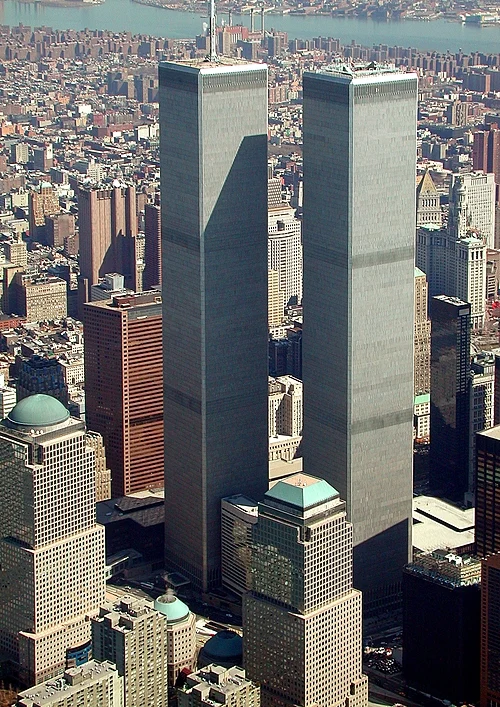
Photograph by Jeff Mock
Go here for the 9/11 Commssion Report.
Go here for my post series on reducing the costs of tragic conflict which presents many insights from my dissertation.
Go here for a preview of my dissertation.
Go here for my many posts on John Dewey including some on tragedy and imagination.
Go here for my two-post series on reducing polarization, demonization, and incivility in America.
Go here for my essay on what the humanities mean to me.
Go here for my posts with political theory.