266. The waking, the sleeping, the dead: Heraclitus on continuous soul-states in fragment 26

Abraham Janssens, Heraclitus (c1601). We know very little about Heraclitus’ life, but he is often depicted as someone bemoaning the world’s follies with aristocratic disdain for the mob and many so-called authorities of his day
Opening Remarks
We’ve come to know the ideas of the Presocratic philosopher Heraclitus of Ephesus (fl. c. 500 B.C.E.) through various fragments quoted by subsequent thinkers in antiquity. These fragments are often perplexing and paradoxical. Indeed, some many even appear contradictory like fragment 49a which reads “We step and do not step into the same rivers; we are and are not” (translation by John Burnet). And they usually employ metaphors, puns, images, and grammar which, as Charles Kahn pointed out in his book The Art and Thought of Heraclitus (Cambridge 1979), generate linguistic density and resonance: “By linguistic density I mean the phenomenon by which a multiplicity of ideas are expressed in a single word or phrase. By resonance I mean a relationship between fragments by which a single verbal theme or image is echoed from one text to another in such a way that the meaning of each is enriched when they are understood together” (89). But these challenges to stable meaning don’t prevent most people from discerning a set of unifying themes such as this set described in the Internet Encyclopedia of Philosophy’s entry “Heraclitus”:
“A Greek philosopher of the late 6th century BCE, Heraclitus criticizes his predecessors and contemporaries for their failure to see the unity in experience. He claims to announce an everlasting Word (Logos) according to which all things are one, in some sense. Opposites are necessary for life, but they are unified in a system of balanced exchanges. The world itself consists of a law-like interchange of elements, symbolized by fire. Thus the world is not to be identified with any particular substance, but rather with an ongoing process governed by a law of change. The underlying law of nature also manifests itself as a moral law for human beings. Heraclitus is the first Western philosopher to go beyond physical theory in search of metaphysical foundations and moral applications.”
This interplay between unity and diversity in the fragments generates a fascinating and mysterious interpretation space which, after some 2,500 years, keeps giving rise to new insights. This has certainly been the case in my own life. I first encountered Heraclitus in 1992 while taking an ancient philosophy class with Professor John Peterman at William Paterson University. I then took two graduate classes on him at the New School (Spring 96′ with the late Professor Fritsche and Spring 98′ with the late Professor Benardete which is archived here). Over the subsequent 30 years they continue to fascinate and perplex me. This perplexity can be tiresome at times and I usually end up with more questions than answers. But in a world where so many things are superficial it is comforting to know I can always return to Heraclitus the Obscure to encounter philosophical depths that appear to have no discernible bottom.
The waking, the sleeping, and the dead?
And return I did the other day when recollecting a dream someone told me about. In this dream her late mother appeared to her in a vision and she was able to access the moving experience to some degree upon waking. I had a set of very similar dreams after my father passed away and upon reflection it seemed that in these cases the waking, the sleeping, and the dead were somehow connected to one another. And this made me think of a Heraclitus fragment which comes to us indirectly via the Christian philosopher Clement of Alexandria (147-215):
ἄνθρωπος ἐν εὐφρόνῃ φάος ἅπτεται ἑαυτῷ [ἀποθανὼν] ἀποσβεσθεὶς ὄψεις, ζῶν δὲ ἅπτεται τεθνεῶτος εὔδων, [ἀποσβεσθεὶς ὄψεις], ἐγρηγορὼς ἅπτεται εὕδοντος
Many translations of this fragment, typically numbered 26 following the Diels-Kranz numbering system, are available and its meaning is often contested in part because the phrases in brackets are contested. I will, however, not enter into such controversies here. Rather, I want to present a translation, discuss one plausible line of interpretation, and offer some observations in support of the ideas conveyed in the interpretation. My aim is not to offer convincing arguments but to open up a mental space in which these ancient and rather cryptic notions can be taken seriously.
A Translation and Interpretation
In his book Heraclitus (University of Toronto Press, 1987) T.M. Robinson translates fragment 26 as follows:
A person in <the> night kindles a light for himself, since his vision has been extinguished. In his sleep he touches that which is dead, though <himself> alive, and while waking touches that which sleeps. (23)

Robinson argues the fragment can be “plausibly interpreted as the description of a form of ‘continuity’ (haphē, literally ‘contact; cf haptesthai) that constitutes a cycle closely analogous to the everlasting cycle of change of the great world-masses (fragment 31)” (93). Charles Kahn concurs: “The description of our psychic experience in terms of quenching and kindling suggests that the soul must have its own mode of exemplifying the cycle of everlasting fire, its own mode of survival and revival where life and death will somehow alternate like sleeping and waking” (The Art and Thought of Heraclitus, 214). Robinson and Kahn refer to the elemental transformations of Heraclitus’ cosmic fragments which can be described as follows:
“Fire is transformed into water (“sea”) of which half turns back into fire (“firewind”) and half into earth. Thus there is a sequence of stuffs: fire, water, earth, which are interconnected. When earth turns back into sea, it occupies the same volume as it had before it turned into earth. Thus we can recognize a primitive law of conservation—not precisely conservation of matter, at least the identity of the matter is not conserved, nor of mass, but at least an equivalence of matter is maintained. Although the fragments do not give detailed information about Heraclitus’ physics, it seems likely that the amount of water that evaporates each day is balanced by the amount of stuff that precipitates as water, and so on, so that a balance of stuffs is maintained even though portions of stuff are constantly changing their identity.” (See the Internet Encyclopedia of Philosophy’s entry “Heraclitus”)
Fragment 26 appears to offer a microcosmic version of such transformations, a psychological version, in which the waking, the sleeping, and the dead are three potential states through which the soul can cycle insofar as it is part of a universe which, according to fragment 30, is an everliving fire being kindled in measures and put out in measures. Robinson offers a helpful elaboration:
“The point is made clearer if one takes Heraclitus’ assertions in reverse order. Our waking selves and our sleeping selves are, as Heraclitus might well have expressed it (fragments 60, 88), ‘one and the same.’ In terms of the cyclical metaphor, there is no break between them, ie, no break in their continuity. The continuity is also such that the soul of the awake person in this world is describable as being at the furthest possible remove from, in the sense of ‘most dissimilar in state to, the soul of that same person when dead, and closest of all to, in the sense of ‘most similar in state to,’ the soul of that same person when asleep. The same can be said for the continuity between the soul of the living person and the soul of the same person when dead; it is once again one and the same soul, but the two ‘states’ thereof are the most similar to each other of all possible states of soul and thus, in terms of the cyclical metaphor, in closest ‘contact’ with each other. At death (ie, at the time of separation of soul and body), the soul, which with the loss of physical sight loses contact with this world, establishes immediate contact, without break in the continuity, with the obscure world beyond by means of its own organ of vision (what Plato will later call ‘the eye of the soul,’ Republic 7.518c, 519b); in terms of Heraclitus’ own metaphor, the ‘striking up’ (haptesthai) of the light (always there but only lit on the occasion it is needed) and the ‘striking up of contact’ (haptesthai) with the next world are one and the same activity, and the soul in question is one and the same soul, in ‘separate’ states that are in fact continuous with one another.” (93)
According to David Vender’s paper “Heraclitus on life after death,” this set of soul transformations, far from being just one interesting facet of Heraclitus’ rich world-view, is actually the key to his teaching which is all too often overlooked:
“The ruling thought that Heraclitus put in his riddles and reversals is not that rivers keep flowing, but that the vast majority of men are asleep when awake and absent when present. This elevates one fragment to a place that in a sense makes it rule all the rest: B26. This is the key fragment to grasp if the unity of what Heraclitus had to say is to be recovered from the fragments. The transformations of the soul through different states of consciousness, from the ordinary use of eyes and ears, through dreams and sleep and on to death and Hades are the logos which [according to fragment 1] men ever fail to understand, even after they have heard it.”
The centrality of these ideas to Heraclitus’ worldview may justify us them taking them seriously as far as scholarship goes. But can we take them seriously as truth claims about reality?
Should we take these ideas seriously?
Well, we might take them seriously if we grew up under the influence of Homer. Francis Cornford, in his classic From Religion to Philosophy (Harper and Row, 1957), points out that “Man in Homer has two souls. His eidolon or psyche escapes from his mouth at the moment of death; it is his recognisable shape, which may, for a time, revisit his survivors in dreams. It does not exist until the moment of death; and it does not carry with it to the world of shades any of his vital force. This resides in the other soul (θυμός), whose visible vehicle is the blood; and it is only by drinking blood that the eidolon can recover its ‘wits’ (φρένες) or consciousness” (111).
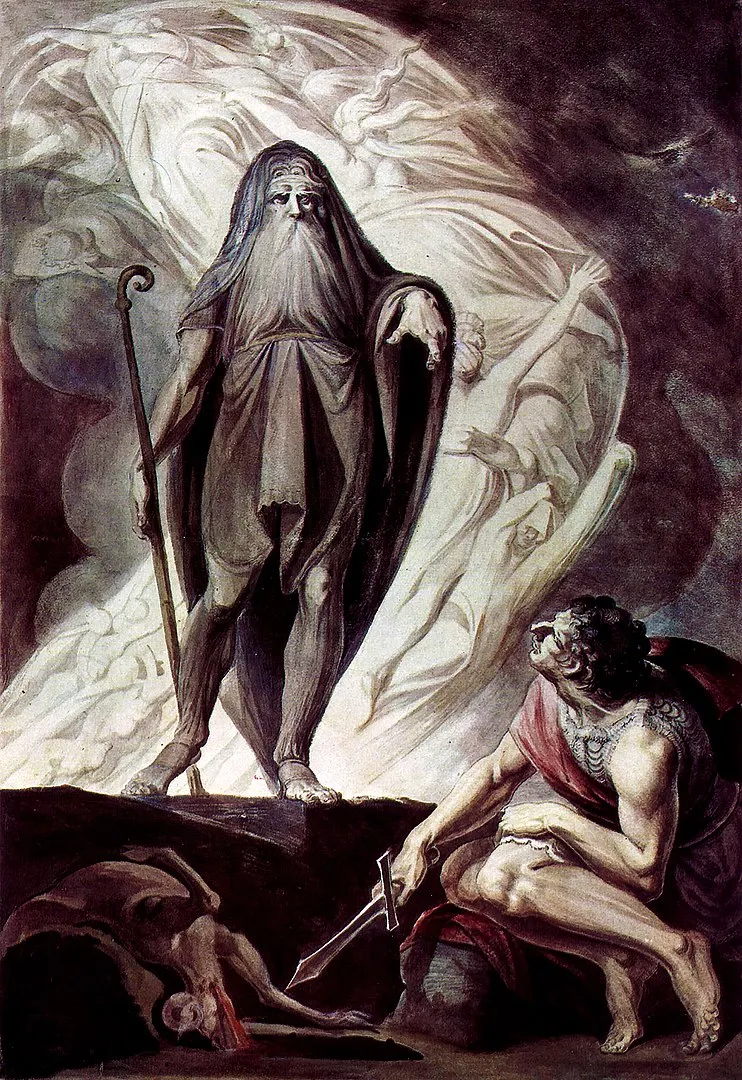
Johann Heinrich Füssli (c. 1780-85), The Shade of Tiresias Appearing to Odysseus during the Sacrifice (Book XI of the Odyssey)
We might also be more open to them if we had the mythological affinity between death and sleep in mind. According to Greeks the twin brothers Hypnos (Sleep) and Thanatos (Death) originate from Nyx (the Night) and dwell together in the underworld. This brotherly relation seems to represent sleep and death as separate but connected realities of some kind. This close connection was beautifully depicted by John Waterhouse in this painting:

John William Waterhouse, Sleep and his Half-Brother Death (1874). The painting expresses the close continuity of Sleep and Death, expressed by their bodily touch, with what appears to be Hades in the background. I like to see us, the viewers of the work, representing the third aspect of wakefulness which would offer a nice aesthetic expression of Heraclitus’ three soul states.
And, while Socrates followed the Presocratics in demythologizing the human condition in many ways, we still come across this passage from Plato’s Apology (the trial of Socrates) which holds out the possibility that he can converse with heroes in Hades after his execution:
“But if death is the journey to another place, and there, as men say, all the dead abide, what good, O my friends and judges, can be greater than this? If indeed when the pilgrim arrives in the world below, he is delivered from the professors of justice in this world, and finds the true judges who are said to give judgment there, Minos and Rhadamanthus and Aeacus and Triptolemus, and other sons of God who were righteous in their own life, that pilgrimage will be worth making. What would not a man give if he might converse with Orpheus and Musaeus and Hesiod and Homer? Nay, if this be true, let me die again and again. I myself, too, shall have a wonderful interest in there meeting and conversing with Palamedes, and Ajax the son of Telamon, and any other ancient hero who has suffered death through an unjust judgment; and there will be no small pleasure, as I think, in comparing my own sufferings with theirs. Above all, I shall then be able to continue my search into true and false knowledge; as in this world, so also in the next; and I shall find out who is wise, and who pretends to be wise, and is not. What would not a man give, O judges, to be able to examine the leader of the great Trojan expedition; or Odysseus or Sisyphus, or numberless others, men and women too! What infinite delight would there be in conversing with them and asking them questions! In another world they do not put a man to death for asking questions: assuredly not. For besides being happier than we are, they will be immortal, if what is said is true.”
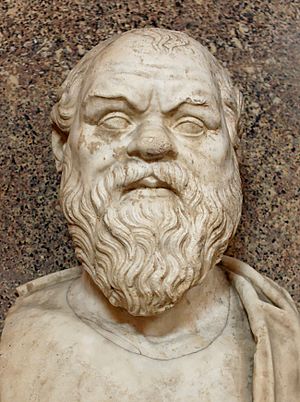
Socrates (470-399 B.C.E)
But surely it is more intelligent for us to think that our dream encounters with lost loved ones are just a function of matter in motion—complex brain activity—with no spiritual reality or significance whatsoever. And surely it is nonsense to believe in a soul which can enter different realms of experience and encounter things in those realms such a physical people, dream images of people, and dead people from Hades. Believing in such things wouldn’t, well, be normal and certainly wouldn’t be in accordance with the widespread materialism of the sciences that typically denies the existence of the soul and the reality of the afterlife.
Taking fragment 26 seriously
However, Heraclitus cautions us against being confident when it comes to our understanding of nature in general and ourselves in particular! Consider these fragments (translated by Burnet):
Nature loves to hide. (frag. 123, Burnet)
You will not find the boundaries of soul by traveling in any direction, so deep is the measure of it. (frag. 45, Burnet)
The hidden connection is better than the open. (frag. 54, Burnet)
Dogs bark at every one they do not recognize. (frag. 97, Burnet)
So let us avoid being barking dogs for the moment and seriously ask: doesn’t it seem obvious that, along with our capacity for visual sight, we also have an eye of the soul that looks at things when, as Heraclitus says, our outward vision is extinguished? In his book God and Forms in Plato (Parmenides, 2005) Richard D. Mohr rightly points out that for Plato “dream-objects…are apprehended on some analogue with seeing. It is important here to remember that for the Greeks one always sees a dream; one does not have a dream. A dream is not a quality that attaches to the mind nor is it a mere activity of the mind. Rather, it is something perceived by the mind’s eye” (220). Isn’t what was true for Plato and the Greeks true for us? After all, when our eye balls move in REM sleep we appear to be looking with another set of eyes that belong to the soul. These eyes can see in the absence of physical light as Eugene Fink notes in his response to Martin Heidegger in Heraclitus Seminar (Northwestern, 1993):
Heidegger: A human sees nothing in the dark.
Fink: Nevertheless everyone sees something in the dark. (131)

Detail from the first page of The Art of Memory (Ars memoriae) in Robert Fludd’s Utriusque Cosmi… metaphysica, physica atque technica Historia (1619). Here we see the mind’s eye, the oculus imaginationis, envisioning a set of captivating scenes (the Tower of Babel, Tobias and the Angel, an obelisk, a sea storm, and the last judgment) with which to connect various concepts to facilitate the art of memory.
And our dreams appear to have, unlike the third-person accessible ontology of physical objects which are in principle detectable by all, a first-person ontology of images which are absolutely private and have never been detected in a brain (neural correlates of images can be studied but not the images themselves). Heraclitus appears to agree:
The waking have one common world, but the sleeping turn aside each into a world of his own (frag. 89, Burnet)
There have been a few philosophers who have taken mental images seriously such as Alastair Hannay in his book Mental Images: A Defense (1971). But many have concluded that mental images don’t exist or, if they do, they certainly aren’t things we see with some kind of inner eye. However, if we do some simple introspection – imagine and look around a bit – perhaps we’ll realize that these ideas shouldn’t be so quickly dismissed.
Now, I’m not saying the above claims are absolutely convincing. But I do think they shed some plausible light on Heraclitus’ notion that when we dream we move from one realm to another: from a public world of things illuminated by physical light seen through our eye balls to a private realm of things illuminated by dreamlight and seen with the eye of the soul. Naturally while we are awake we can see things with the eye of the soul as well as we imagine, daydream, plan, and so on. And we can sometimes recall, quite vividly, our dreams. So this would make sense of his notion that we are in touch with sleep while awake.
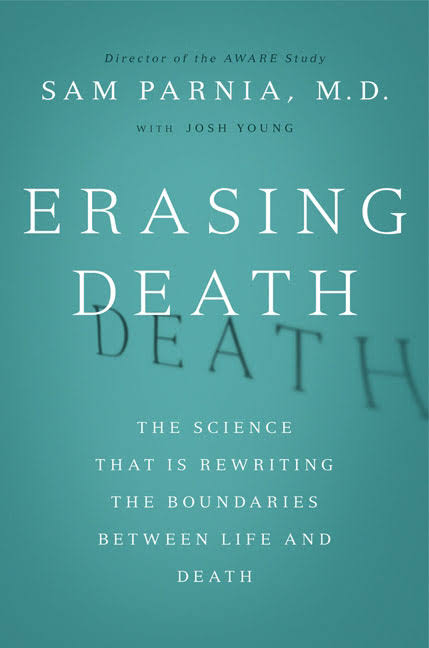
But what about touching the dead in our sleep? Most of us dream and, while we may struggle to know exactly what happens in our dreams, we are usually confident that we have them. But can we find any support for the existence of a shadowy realm where the dead live? Well, we might take people’s visionary encounters with the dead in their dreams as evidence for it. Such evidence won’t be scientific insofar as it doesn’t lead to falsifiable predictions. But it can be a form of evidence nonetheless. And then there is the testimony of near death experiences and after death experiences. In his book Erasing Death (Harper One, 2013), Sam Parnia, M.D. has assembled scientific evidence of the afterlife based on the testimony of people whose consciousness persisted even after they died, that is, after “All bodily functioning, and in particular brain functioning, ceases within seconds of the heart stopping. There is thus no heartbeat, no respirations, and the pupils of the eye become fixed and dilated (due to lack of blood flow to the brain)” (217). He admits that his research cannot tell us whether or not the soul is immortal. But he thinks the evidence shows
“that at least for the first few hours after death, which is the time where we can study things today and also bring a person back to life, the mind, consciousness, psyche, or soul – whatever term we wish to use for the “self” – continues to exist. In the cases where we manage to reverse the process of death and resuscitate the person “back to life,” even many hours after death, the person’s consciousness, self, or soul will also come back. So by definition there has to be some sort of “afterlife,” even if only for a few hours after death.”
People who have come back to life as we know it have reported transformative encounters that have changed their lives for the better. For example, Parnia tells us about Joe Tiralosi’s ADE in which he “encountered a luminous, loving, compassionate being that gave him a loving feeling and warmth” (8). As a result of this experience “he said he was no longer afraid of death” (9). Parnia tells us that “people who undergo an experience like Tiralosi’s truly seem to be in a new world – one in which death, for them, is nothing to be afraid of…Like others who have reported experiencing such an event, he came out of this feeling less materialistic and more altruistic” (9).

John Roddam Stanhope Spencer, Charon and Psyche (1883)
We can turn to Plato for some supporting arguments as well. For example, in Phaedo Socrates argues (69E-72E) that all contraries come from on another and this might both shed light on fragment 26 with its cycle of soul states and open up the possibility that the realm of the dead he mentioned at his trial may indeed exist. Consider these passages (translated by Jowett):
Socrates: Well, and is there not an opposite of life, as sleep is the opposite of waking?
Cebes: True, he said.
S: And what is it?
C: Death, he answered.
S: And these, if they are opposites, are generated the one from the other, and have there their two intermediate processes also?
C: Of course.
S: Now I will analyze one of the two pairs of opposites which I have mentioned to you, and also its intermediate processes, and you shall analyze the other to me. One of them I term sleep, the other waking. The state of sleep is opposed to the state of waking, and out of sleeping waking is generated, and out of waking, sleeping; and the process of generation is in the one case falling asleep, and in the other waking up. Do you agree?
C: I entirely agree.
S: Then, suppose that you analyze life and death to me in the same manner. Is not death opposed to life?
C: Yes.
S: And they are generated one from the other?
C: Yes.
S: What is generated from the living?
C: The dead.
S: And what from the dead?
C: I can only say in answer—the living.
S: Then the living, whether things or persons, Cebes, are generated from the dead?
C: That is clear, he replied.
S: Then the inference is that our souls exist in the world below?
C: That is true.
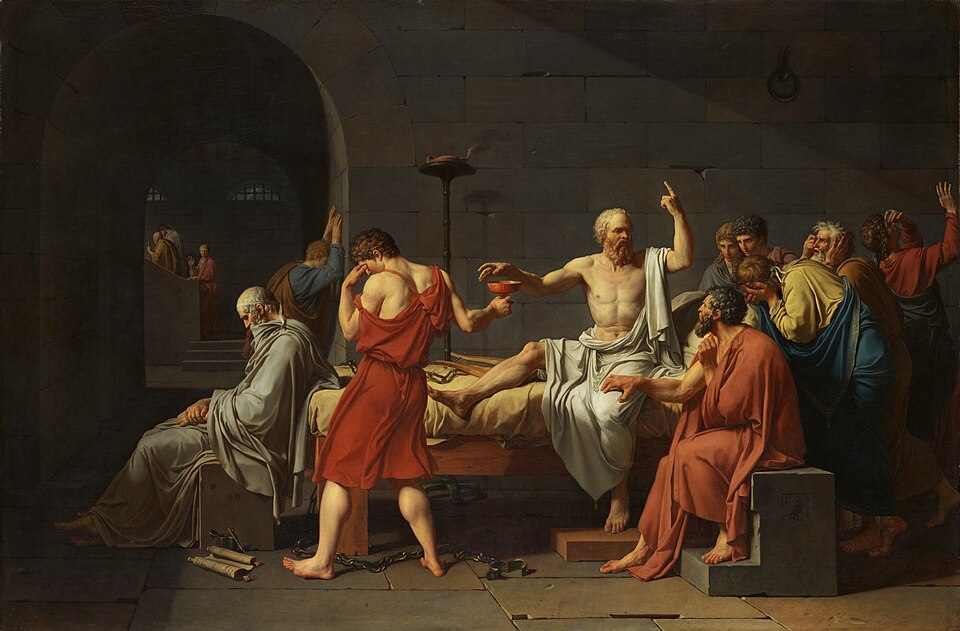
Jacques Louis David, The Death of Socrates (1787) which depicts an imagined scene, Socrates in prison about to drink the poison hemlock, from Plato’s Phaedo
And in Phaedo (78B-84B) Socrates also argues that the soul may not disintegrate since only material composites like bodies disintegrate and the soul is not composite. And if it can’t disintegrate then maybe it is immortal. Socrates argues that the soul is immaterial from the fact that it is invisible and is more akin to unchanging reality than the visible changing reality we experience around us. According to Plato, this unchanging reality is the realm of Being populated by the Forms which are the immaterial, eternal, and perfect standards we come to know when we know something. The Forms, being immaterial, are not physical composites: they are simple. The soul, insofar as it can make contact with them, must therefore be immaterial and simple as well. Consider these passages which pick up on the above reference to a “world below” and introduce the notion of the true Hades (translated by Jowett):
Socrates: And do you further observe, that after a man is dead, the body, or visible part of him, which is lying in the visible world, and is called a corpse, and would naturally be dissolved and decomposed and dissipated, is not dissolved or decomposed at once, but may remain for a for some time, nay even for a long time, if the constitution be sound at the time of death, and the season of the year favourable? For the body when shrunk and embalmed, as the manner is in Egypt, may remain almost entire through infinite ages; and even in decay, there are still some portions, such as the bones and ligaments, which are practically indestructible:—Do you agree?
Cebes: Yes.
S: And is it likely that the soul, which is invisible, in passing to the place of the true Hades, which like her is invisible, and pure, and noble, and on her way to the good and wise God, whither, if God will, my soul is also soon to go,—that the soul, I repeat, if this be her nature and origin, will be blown away and destroyed immediately on quitting the body, as the many say? That can never be, my dear Simmias and Cebes. The truth rather is, that the soul which is pure at departing and draws after her no bodily taint, having never voluntarily during life had connection with the body, which she is ever avoiding, herself gathered into herself;—and making such abstraction her perpetual study—which means that she has been a true disciple of philosophy; and therefore has in fact been always engaged in the practice of dying? For is not philosophy the practice of death?
C: Certainly—
S: That soul, I say, herself invisible, departs to the invisible world—to the divine and immortal and rational: thither arriving, she is secure of bliss and is released from the error and folly of men, their fears and wild passions and all other human ills, and for ever dwells, as they say of the initiated, in company with the gods. Is not this true, Cebes?
C: Yes, beyond a doubt.
Of course these arguments are offered tentatively by Socrates and when analyzing them we need to be sensitive to the context of the dialogue and especially the types of characters involved. Nonetheless, they are interesting arguments which we may develop as we carry Plato’s ancient dialogue forward in our own discussions.
Finally, if we stick with the Heraclitean materials at hand we might argue that our ability to privately see mental images suggests we are more than just a body: we are also a soul or immaterial substance that can think, perceive, and imagine such images. After all, if we were completely physical it is hard to understand how we could each enter “a world of our own” and see things in our mind’s eye that do not appear in the brain. And if these considerations support immateriality then, following Plato, we might have some hope that, as Socrates says, the soul will not be “blown away” upon death but will make its way to the true Hades.
To be sure, the introduction of immateriality seems to be foreign to Heraclitus. Aristotle did note in Book I of his On the Soul that Heraclitus’ notion of the soul was the most incorporeal of the Presocratics: “Heraclitus too says that the first principle — the ‘warm exhalation’ of which, according to him, everything else is composed—is soul; further, that this exhalation is most incorporeal and in ceaseless flux; that what is in movement requires that what knows it should be in movement; and that all that is has its being essentially in movement (herein agreeing with the majority).” And Heraclitus asserts that “Corpses are more fit to be cast out than dung” (frag. 96, Burnet) which suggests he didn’t think, as Greeks at the time thought, that the soul’s successful passage to the afterlife was closely tied to the proper care and burial of the body. But complete immateriality of the soul seems to subsequently appear with Plato. Still, it is interesting to think about. As we saw in Robinson’s explanation above, Heraclitus appears to think there is a continuity between soul states and their cycles rather than strict breaks. So if we did want to include immateriality then perhaps we could say ultimate reality, which Heraclitus calls fire, is neither material nor immaterial but rather, as neutral monism maintains, something neutral that can take on material and immaterial properties as it cycles through changes such as the waking, the sleeping, and the dead.
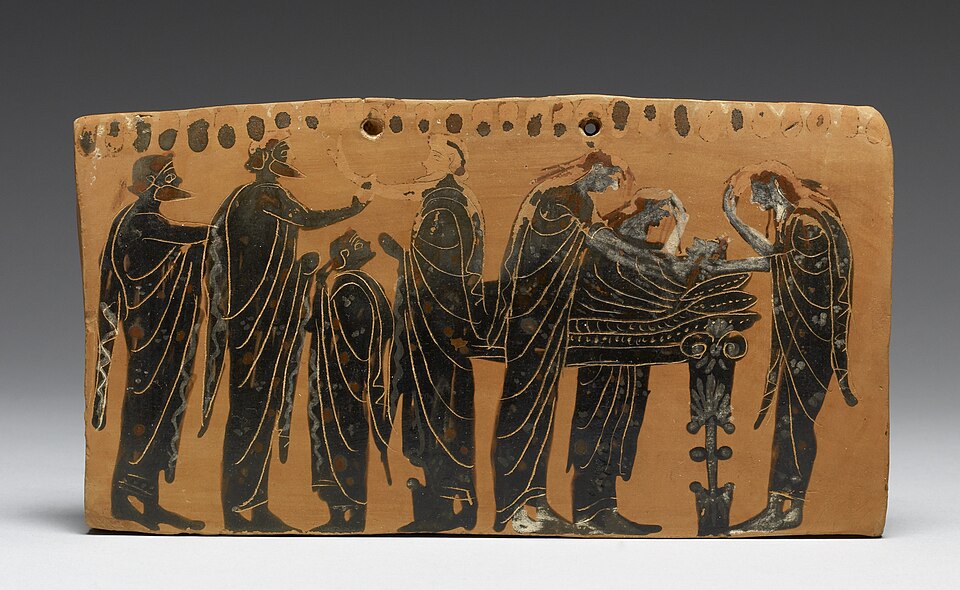
“The lying in state of a body (prothesis) attended by family members, with the women ritually tearing their hair, depicted on a terracotta pinax by the Gela Painter, latter 6th century BC” (Wikipedia, “Ancient Greek funeral and burial practices”). Heraclitus appears to have thought such rituals a waste of time since “Corpses are more fit to be thrown out than dung.”
Again, I’m not trying to be convincing here (see the link below for my preferred argument for the soul or substance dualism). It is probably wise to agree with Philip Wheelwright who, in his book on Heraclitus, stressed that “there is always more than meets the eye in anything so essential and ontologically primary as the transition known as death. The mystery of death is not something that can be expressed in straightforward language. All such language carries with it associations that have been developed out of the familiar experiences of everyday life; how, then, could it possibly be adequate to describe the nature of something so utterly unfamiliar and mysteriously trans-human as after-death experience, which “we can neither expect nor have any conception of” (Fr. 67)? Heraclitus, like every serious poet, perceives the limited expressiveness of everyday language and employs certain devices, particularly metaphor and paradox, for pointing, however uncertainly, beyond it” (78). Heraclitus does tell us that “Souls smell in Hades” (frag. 98, Burnet) which might be the only sense left to souls as they move into a vaporized, ghost-like state. But ultimately
There awaits men when they die such things as they look not for nor dream of. (frag. 27, Burnet)
Concluding Speculation
And I suppose that is what this post has basically been doing—just pointing to things I’ve been considering and offering you, with the help of a set of possible interpretations of Heraclitus’ fragments, the opportunity to think about them as well. It really might be the case that, as he says in a fragment which we can take as addressed to us,
They are estranged from that with which they have most constant intercourse. (frag. 72, Burnet)
But we won’t overcome such estrangement if we don’t expect the unexpected:
If you do not expect the unexpected, you will not find it; for it is hard to be sought out and difficult. (frag. 18, Burnet)
Some of these ideas may be a bit unexpected. But who knows? If we can keep an open mind we might come to see that, despite plenty of common sense experience to the contrary, that
It is the same thing in us that is living and dead, awake and asleep, young and old; the former are changed around and become the latter, and the latter in turn are changed around and become the former. (frag. 88, Burnet with some changes)

The name Heraclitus (outlined in red) in a fragment of the Oxyrhynchus Papyri (the collection of ancient manuscripts, public records, and letters discovered in an ancient rubbish dump in Egypt by classicists Bernard Grenfell and Arthur Hunt in 1897)
© Dwight Goodyear 2026
Go here for my post on Heraclitus’ view of justice as strife.
Go here for my post sympathetic to Heraclitus’ view of humans as barking dogs.
Go here for Heraclitus’ fragments translated by John Burnet.
Go here for David Vender’s paper “Heraclitus on life after death” which offers a helpful list with commentary of various translations of fragment 26 over the years.
Go here for my post on substance dualism which includes links to my others posts on the soul.
Go here for my posts on Plato.