262. Experiencing daily cognitive dissonance? Admit the U.S. is an oligarchy in order to think and act more effectively.
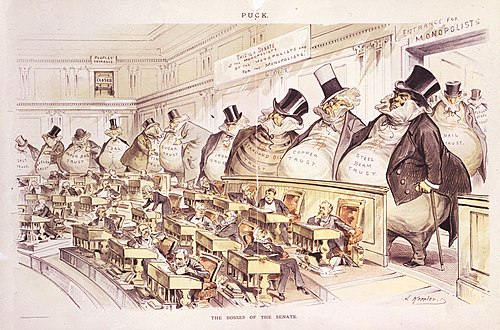
Joseph Keppler, The Bosses of the Senate (1889)
Recently my post-breakfast experience included yet another piece of news that created cognitive dissonance. This time it was from a May 2026 NPR article and read:
“The U.S. government will permanently drop tax claims against President Trump, according to a settlement document made public Tuesday, in an extraordinary use of executive power that could effectively help shield the president from further examination of his finances and legal conduct. As part of the settlement deal meant to resolve Trump’s $10 billion lawsuit against the Internal Revenue Service over the leak of his tax returns, the U.S. is “forever barred and precluded” from examining or prosecuting Trump, his sons and the Trump organization’s current tax examinations, according to a one-page document posted to the Justice Department’s website.”
And today it was one of the most grim of all: on June 29, 2026 the Supreme Court, in their decision regarding Trump v. Slaughter, ruled 6-3 that the President has the constitutional authority to fire heads of independent federal agencies at will. The decision overturned a 90-year-old precedent and justified the immediate removal of Federal Trade Commission Commissioner Rebecca Slaughter for political differences. And this goes a long way in helping Trump fully realize the vision of unitary executive theory which states that Article II of the U.S. Constitution vests all executive power directly in the President to supervise, direct, and remove all federal officers and executive agency personnel. As Heather Cox Richardson rightly observes in the June 29, 2026 edition of her Substack Letters from an American, “Now, even if the American people elect members of Congress who create agencies to protect our interests, the president can gut them and turn them to his own purposes.” She goes on explain:
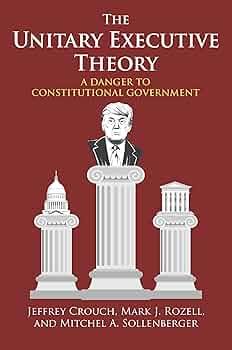
“Justices Sonia Sotomayor, Elena Kagan, and Ketanji Brown Jackson dissented. They noted that throughout our history, both Congress and the president have agreed that some of government’s functions should operate outside of party politics. Financial management, workplace safety, consumer safety, addressing environmental hazards, and managing nuclear energy, for example, should not depend “on who is in office—much less on who is disfavored or owed a favor by those in office—but also on judgment, expertise, and the public good.”
“Since the founding, Congress has created agencies that in various ways have embodied this goal of independence. Over the last 140 years especially, the political branches have done so by establishing agencies like the Federal Trade Commission (FTC): bipartisan, multimember bodies with “for-cause” removal protections. This structure allows the agencies to address complex problems while enjoying some independence from Presidential removal and thus absolute partisan control.”
“Today,” though, they write, “this Court undoes centuries of political practice and concludes that all three branches of Government have been acting in open defiance of the Constitution all this time. Its conclusion is wrong…. [T]he Court gives the President a power unknown even to the English Crown against which the Founders revolted, elevating him above his once-coequal branches by transforming a duty to take care that the laws be faithfully executed into a license to act in defiance of those very laws.”
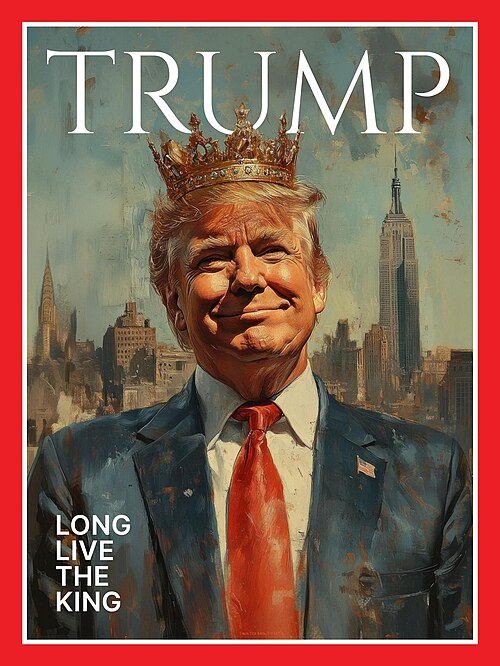
“White House social media [in February 2025] posted an image depicting Trump as a king, showing the administration’s expansive view of presidential power” (Wiki)
These headlines, as well as literally hundreds of similar ones over the past decade, just seem, given my background beliefs about human decency, checks and balances, and imperfect but present rule of law in the United States, to make no sense. Here and there I’ve been pleased to see justice prevail like when, on June 29, 2026 the Supreme Court upheld a Mississippi law allowing mail-in ballots to be counted or when, on June 30, 2026, the Supreme Court struck down a 2025 executive order that attempted to deny citizenship to those born on U.S. soil to undocumented parents or temporary visa holders. But for the most part I live with ongoing cognitive dissonance.
Cognitive dissonance can, of course, be a good thing insofar as the contradictory mental friction it causes is a powerful impetus to find a set of beliefs and practices that are consistent. In this case, I’ve found that accepting we live in an oligarchy has brought the resolution I was seeking which, in turn, has opened me up to solutions I might have otherwise missed. Bernie Sanders, in his book Fight Oligarchy, offers a definition of oligarchy and connects it to our present American context:
“Oligarchy is a system in which a small number of extremely wealthy individuals control the economic, political, and media life of a nation. It is a system in which ordinary people have very little power to determine the future of their country. If you’re an American, it is the system in which you’re living. That must change. In the wealthiest nation on earth we must build a political movement that creates a government that represents all Americans, not just a handful of billionaires.”
Accepting the U.S. is an oligarchy took a while for sure. The thought was planted in my mind back in 1992 when I read Aristotle’s discussion of oligarchy in his Politics and made plenty of connections with our government. Peter L.P. Simpson expresses these connections beautifully in his short book Aristotle’s Regime of the Americans which poses as a critique (offered in both Greek and English) of American culture and politics by Aristotle himself. Consider these passages:
“These then are the chief offices in the regime of the Americans, which, as we said, they call a democracy. That it has nevertheless many oligarchic features, with some of these deviating to extreme oligarchy, is clear. But they think this to be a noble thing and even a way of preserving the democracy. For the regime is democratic in two ways in particular, in the electing of the monarchs and senates and assemblies by all the populace, and also in their way of life. For pretty well every American lives as he likes or, as Euripides says, “with a view to what he craves.” So, since living as they like requires abundance of resources, they spend their lives in getting money, and they especially admire those who have been successful in business and have invented new devices for everywhere acquiring wealth. As even one of their monarchs once said, “the business of America is business.”
“So great indeed is their love of making money that they both put political office up for sale (for no one can get elected to office who does not have much money himself, or rich friends, or belongs to one of the political clubs), and use it as a source of income. For all office-holders receive wages for being in office, and holding office enables them to make money in many ways, as especially in receiving gifts from those of the rich who want political favors to be handed out to them. Further these office-holders have control of large public funds from taxes which they guard and hand out to their friends and followers among the populace. The result is that everything is in perpetual flux, monetarily speaking, both up and down: private funds coming from friends and populace to office-holders and public funds going from office-holders to friends and populace.”
“Now it is a base thing that in the regime of the American they allow the rich and those from the political clubs to occupy all the offices at once. But it is baser still to allow people from one and the same political club to occupy them all at once (as does happen if one club is more influential than the rest). For these are both deviations toward oligarchy, and the latter especially so. The separation of powers, in fact, must be deemed an oligarchic sophistry of the rich wanting to keep the regime to themselves. For while they impress upon the populace that this separation of powers is needed to prevent any office-holder becoming too powerful and setting up a tyranny, they hide the fact that all these offices are together in the hands of themselves and their friends. A remedy for this would be to divide the offices, not only from each other, but also among the different parts in the city, so that those who are not rich nor members of the clubs also take part in them. For the Americans already adopt this arrangement in their courts where they require the populace always to take part. They should do the same in the other offices as well, as for instance in their monarchies, since these could be occupied by many together ruling jointly instead of by one man. For where all are similar and equal, justice requires, not that some always rule and others never, but that all take turns in ruling and being ruled. As things stand now, however, the offices are all in the control of the rich and the poor are excluded.” (8-9, 13)
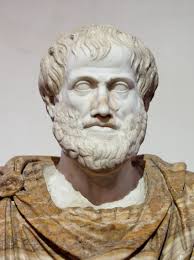
Aristotle (384-322)
For many years I resisted thinking of the U.S as an oligarchy despite these Aristotelian insights. But I began to change my mind some ten years ago when I came across Simpson’s own analysis in his book Political Illiberalism (2015). I disagreed with some of Simpson’s illiberal conclusions, but I found his account that the U.S. is an oligarchy plausible in many ways. Consider these claims:
1) “The first fact is that elections for office must inevitably favor the privileged few. Elections are won by number of votes cast in one’s favor and no one can receive many votes who is not known and admired by many. The features that attract attention and give renown are wealth, high social class, prominent family, conspicuous achievement, striking physical beauty, and the like.” (32)
2) “A second fact is that the more numerous the voters the fewer will be the notables who are likely to win any great number of votes.” (32).
3) “A third and closely related fact is that election campaigns are expensive and require leisure from necessities so that one may spend all or most of one’s time seeking votes. Only the wealthy and privileged or those supported and maintained by the wealthy and privileged can afford either the money or the time. The middle class and the mass of the poor can afford neither.” (32)
4) “A fourth fact is that elections are never just a matter of casting votes for whomever one wills, for there is also the advance selection of candidates. When it comes time for the people to choose their representatives, the existing representatives along with their friends and paid retainers (the political parties and their agents) have already determined the candidates for whom alone the people may vote.” (32)

He continues with reference to Aristotle:
“Such facts have become true of politics in the United States because of the United States Constitution. They did not and could not become true of it under the Articles of Confederation. Such facts also prove the United States to be an oligarchy as can be seen from the following list of oligarchic features, all of which can be seen to apply to the US:
1) All the offices are chosen from some, namely the rich and privileged and their protégés.
2) These some are always the rulers (as a class if not as individuals) while the poor and unprivileged are always ruled.
3) No offices are chosen by lot.
4) High property qualifications are, de facto [in fact] if not de jure [by law], required for office.
5) The same individuals, by being repeatedly reelected, occupy the same office often or always.
6) All the offices are of long duration (none last only a year).
7) The same class or their protégés also become the judges and lawyers and decide questions of law, even controlling, to a large extent, the composition of juries; certainly this class and the elected officials control the most important cases, as those to do with the giving of accounts and with the regime and private contracts.
8) There is no popular assembly and the people as such control nothing.
Not all these features were necessarily realized at once (as in particular the choosing of Senators which, as already noted, has only been by popular election since 1913). But the chief oligarchic features were there from the beginning….We call it representative democracy, as remarked before. Indeed we pride ourselves on the discovery of representation, holding it to be something of which the ancients were ignorant. But Aristotle knew of it. He refrained, however, from calling it either representation or democracy. He called it, as just indicated, demagogic oligarchy. Our term of representative democracy, and our praise of it as a way to extend democracy to vastly greater numbers of people than ancient democracies ever conceived of, he would call oligarchic sophistry. It is a trick to make people believe they share rule when in fact they do not. We should, then, according to Aristotle, pride ourselves, if pride be the right word, not on discovering universal democracy but on discovering universal sophistry.” (34)
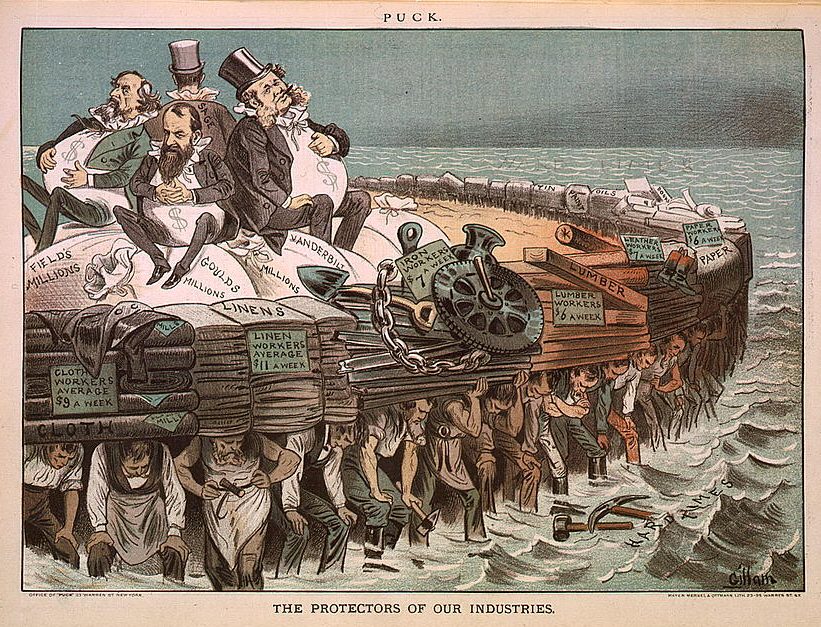
Bernhard Gillam, Protectors of our Industries (1883)
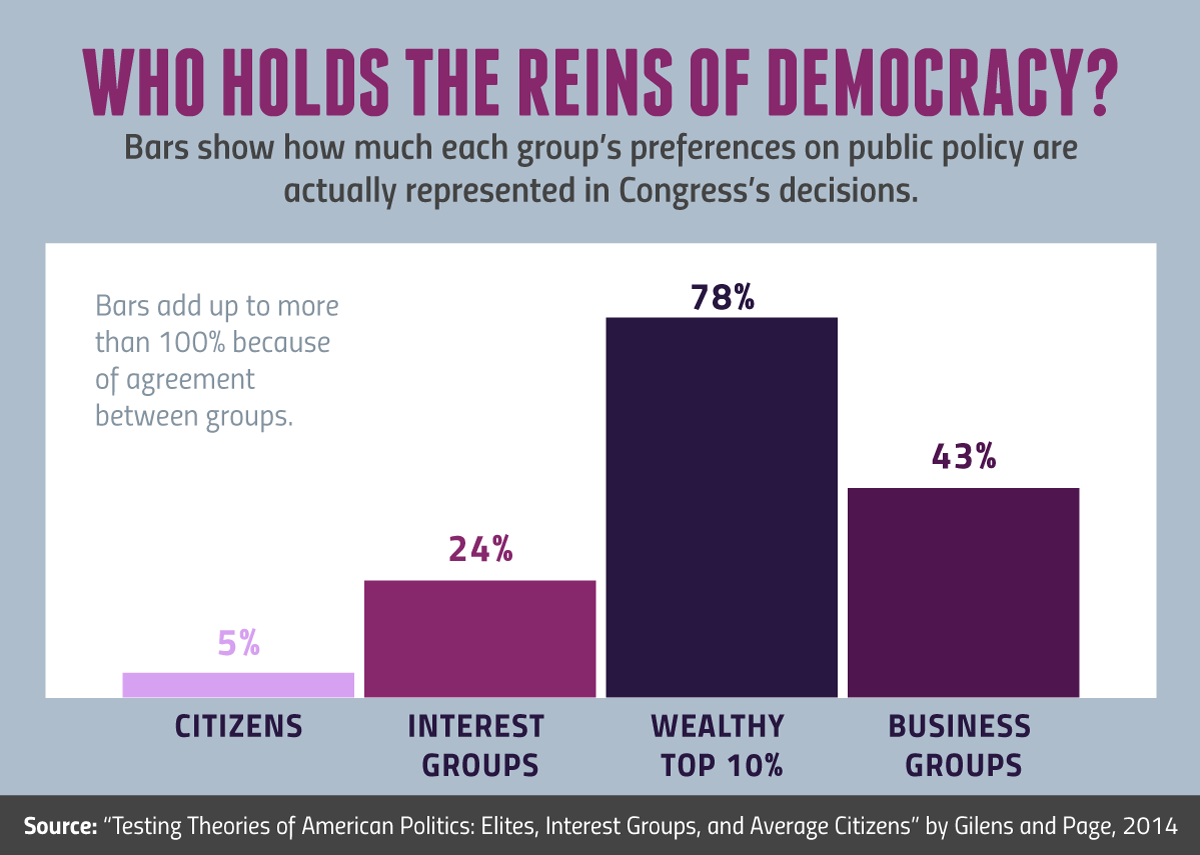
Since reading Simpson I’ve come across plenty of other accounts that add particular and contemporary details to his general critique. For example, David M. Driesen, in his 2024 SMU Law Review Forum article “Donald Trump and the Collapse of Checks and Balances,” concludes “Checks and balances, while not yet completely gone, have collapsed to a significant degree. President Trump and his supporters have plans to erode them further. All of this conforms to the patterns seen in other societies where an autocratic leader gets elected and then impairs or destroys a functioning democracy with the aid of his political party and a captured Court.” Erwin Chemerinsky and Lisa Tucker, in their 2026 article “When the Guardrails Fail: Trump’s Assault on Checks and Balances,” argue that Trump’s second term has included unprecedented efforts to expand executive power, often disregarding statutory limits, restructuring federal agencies, and firing officials in violation of federal law. He has repeatedly ignored congressional spending mandates, used emergency powers without legal basis, and weaponized executive authority against law firms, government officials, and institutions. They conclude “The first year of this [second] Trump presidency has seen an unprecedented effort to increase executive power and undermine checks and balances. It is too soon to know if the guardrails of democracy will hold, but the axiom of systemic fragility would predict that the president’s overreach into the workings of these closely connected institutions may well bring about the death of the rule of law.” And a study done by Martin Gilens and Benjamin Page (from Princeton and Northwestern respectively) demonstrates that, after analyzing 1,779 policy decisions, the people of the United States have only 5% influence on the decisions of Congress whereas interest groups have 24%, business groups have 43%, and the wealthy (top 10%) an astonishing 78%:
If we had a democracy then we should be represented by the table in the upper left:
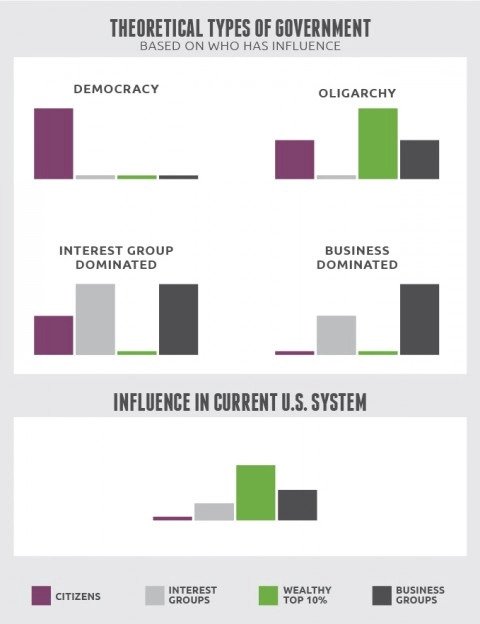
And this disturbing study was published in 2014. Since then we’ve witnessed many more troubling facts, like those I mentioned in the introduction of this essay, and these:
Elon Musk, who momentarily reached trillionaire status in June 2026, owning more wealth than at least half the American households combined.
The top 1% owning more wealth than the bottom 93%.
The CEOs of large corporations making some 350 times more than their average employees.
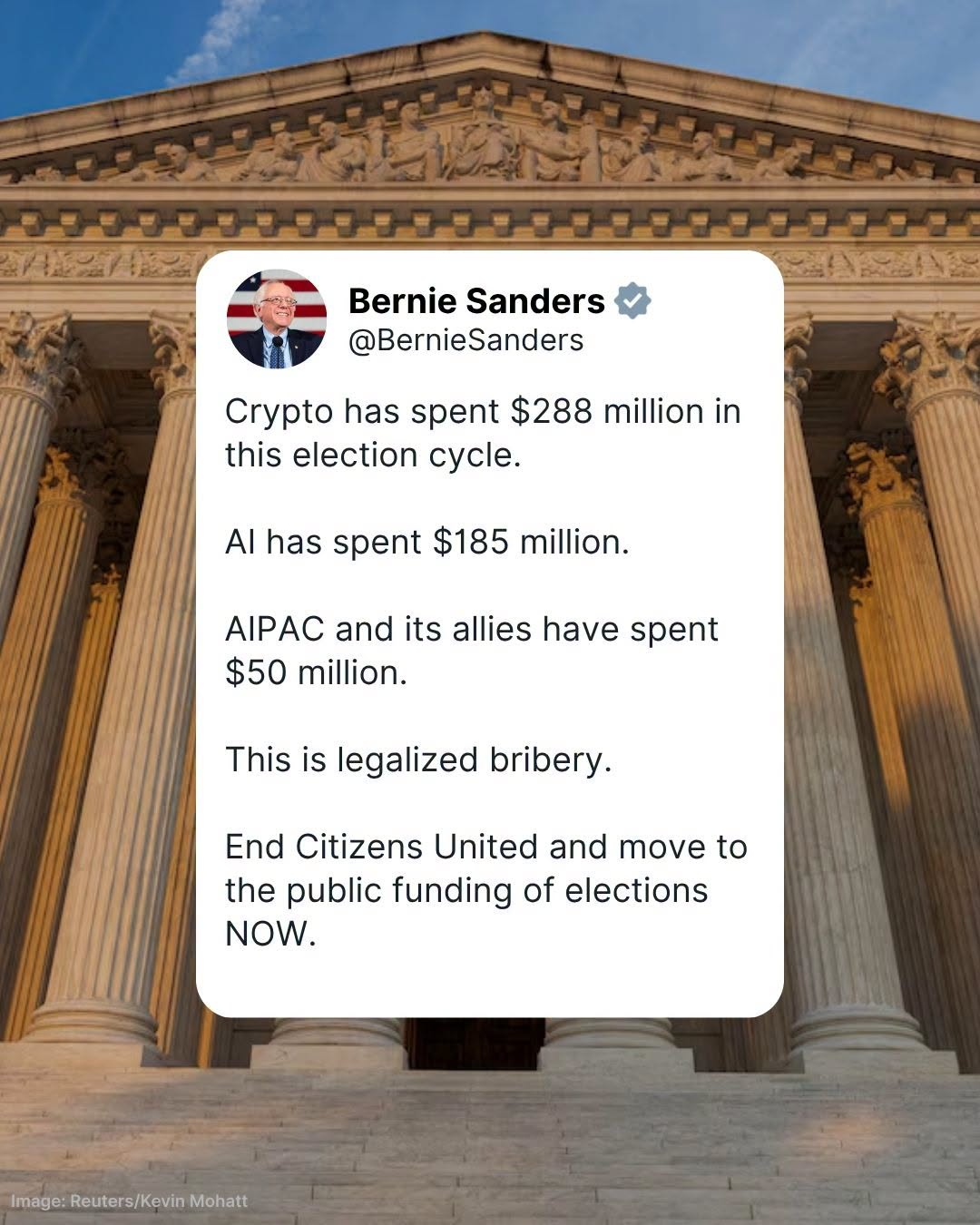
As Sanders points out in an op-ed, today we have more income and wealth inequality, more concentration of ownership, more corporate control of the media, and more billionaire money influencing policy than ever before.
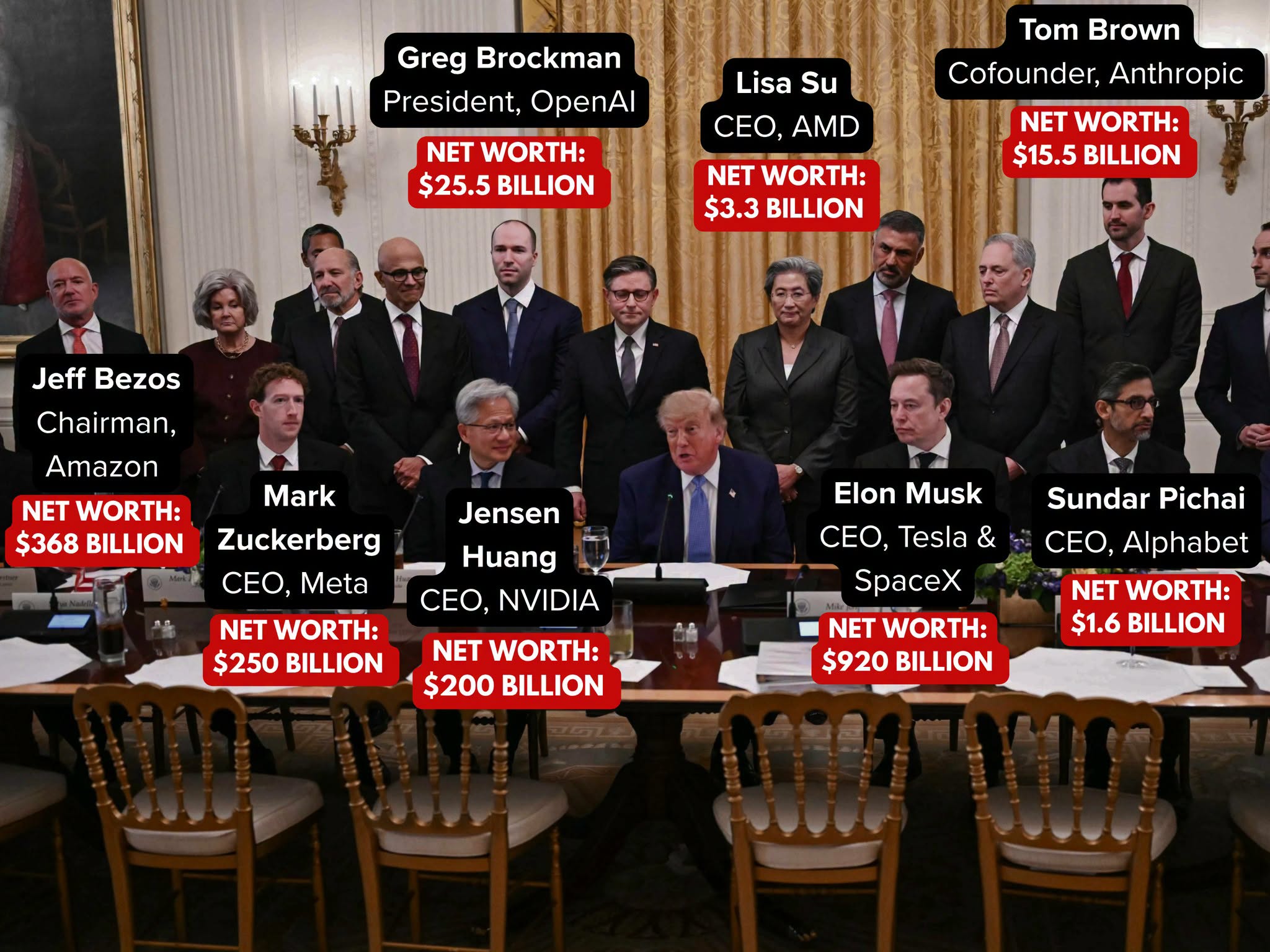
And obviously we have to add to this an unjust war with Iran (declared by Trump rather than Congress as legally required and lacking just cause since, contrary to Trump, there was no “immanent threat” to the U.S. from Iran) which has cost some 113 billion dollars in tax payer money as of June 2025 (an estimated $1000 / household) but appears to be good news for insider trading and is allegedly making Trump’s sons wealthy off their drone investments.
As the above political cartoons from the late 1800s show, concerns about oligarchy in America are not knew. And, just like other forms of government, oligarchies can be quite varied and we are not necessarily living under the most pernicious form. As the above study shows, there are some policies affected by the will of the people. In light of this minor influence we could, as Sanders himself does, say we live in a “semi-democracy” or something like that. We might then see the phrase “we are living in an oligarchy” not as a factual statement but as a helpful heuristic device that brings certain patterns of oppression into focus. But I’m getting tired of these suggestions which increasingly sound like, to use Simpson’s imagined Aristotelean response, oligarchic sophistry. I think it is wiser to accept that we are indeed in an oligarchy so that we can stop feeling the cognitive dissonance which wastes our energy, make us frustrated, and lands us in efforts to solve problems that in many cases can’t be solved based on the assumptions we keep making. As we all know, we need to have an accurate diagnosis if we hope to receive a successful treatment. Accepting we live in an oligarchy can be the first step to more fruitful ways of thinking and acting about our dying democracy. Indeed, every time I encounter yet another example of injustice that favors the wealthy I simply say:
This is what we would expect in an oligarchy.
Once I do my dissonance often vanishes and I’m able to shift to new perspectives that reveal oligarchic machinations with explanatory power.
But what are we to do once we see things from these new and alarming perspectives? Well, first and foremost it is important to carefully describe and verify what we are seeing lest those who would defend the status quo think we are exaggerating, offering conspiracy theories, and so on (my post is an effort to satisfy this condition). And then we have to come up with action points for change and do something. Unfortunately, most of us are busy doing plenty of other things just to make ends meet...which is what we would expect in an oligarchy. So it can be difficult to do anything, let alone everything, we need to do. Luckily, there are plenty of resources to help which you will see in the links below. For one accessible place to start I recommend Sanders’ Fighting Oligarchy which is a short, cheap, and readable book that offers plenty of facts, verifications, and the following action points which are given helpful exposition with practical directions on pp. 119-131:
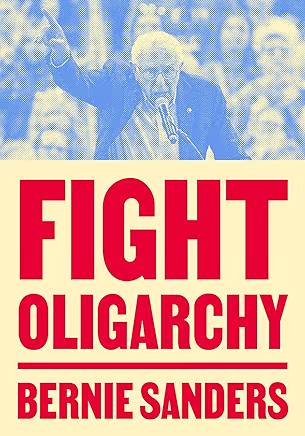
1) Overturn the Citizens United ruling and enacting a constitutional amendment to ban unlimited corporate contributions in elections (this refers to The Supreme Court’s 2010 ruling in Citizens United v. Federal Election Commission that reversed campaign finance restrictions and allowed corporations and interest groups to spend unlimited money on elections. Take note that on June 30, 2026 the Supreme Court, in a 6-3 vote, struck down a federal law that limited the amount of money that political parties can spend in coordination with a candidate for office. The majority opinion, written by Justice Brett Kavanaugh, asserted that limits on spending violate the First Amendment).
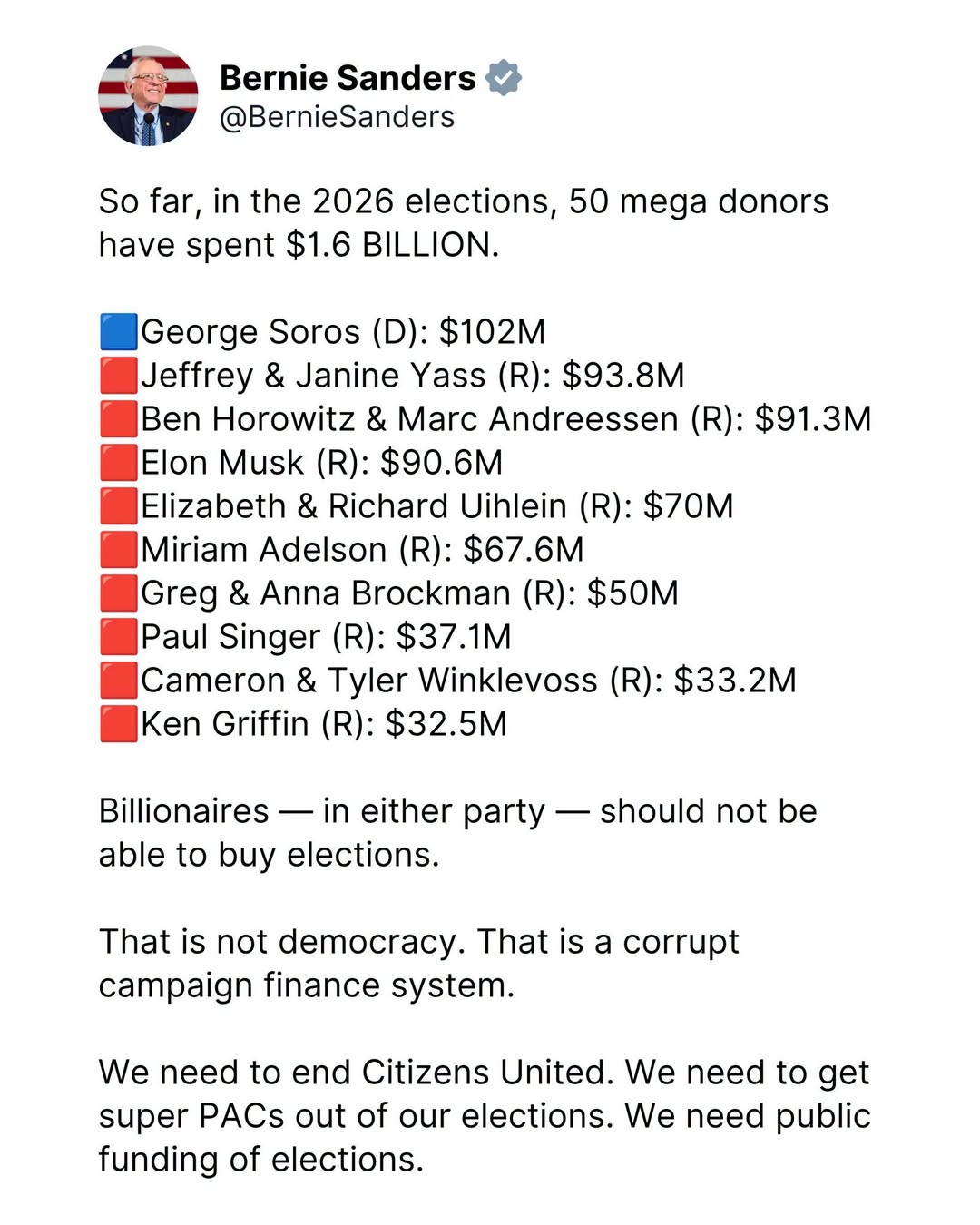
2) Raise new revenue by making the wealthy and large corporations pay their fair share of taxes.
3) Cut military spending and invest in public needs such as affordable housing, public education, and infrastructure projects.
4) Make certain that the working class benefits from new technology, especially AI and robotics.
5) Guarantee basic human needs such as health care, education, nutrition, housing, and retirement security all of which should be human rights,
6) Enact medicare for all.
7) Provide quality education for all.
8) Make housing affordable.

9) Improve wages and benefits for American workers.
10) Pass the PRO act (The Protecting the Right to Organize Act).
11) Raise the federal minimum wage to a living wage (from the appalling $7.25 which has remained the same for 16 years and counting) to at least $17.
12) Guarantee paid medical and family leave.
13) Expand social security.
14) Bring back defined benefit pensions.
15) Encourage employee ownership.
These action points are currently being associated with democratic socialism which typically maintains that the economy and society should be run democratically by everyday people for their needs rather than the needs of the wealthy. This entails both replacing capitalism with an economic system in which the means of production for key services are publicly rather than privately owned and preserving various democratic procedures (unlike forms of authoritative socialism such as the former Soviet Union). However, the action points are also advocated by plenty of social democrats who aim to regulate and reform capitalism with robust programs while keeping private ownership of the means of production intact. And people from other political perspectives may find some or all of them attractive as well. So I think the focus should be more on fighting oligarchy and less on what party people belong to. After all, oligarchy doesn’t just thrive on people feeling so frustrated, tired, and hopeless that they do little or nothing to change their condition. It also thrives on people thinking they have very little in common with each other so they fight amongst the themselves rather than against their true oppressors. But one thing which is clear in an oligarchy is that the people, regardless of what divides them, are necessarily united in their shared unjust oppression. The more we see this and do our best to resist together the more we can hope for significant change. Of course, given the oligarchic powers that be it is foolish to be optimistic about the prospects of quick and radical reform. But given all the positive and inspiring reforms in U.S. history, many of them against seemingly overwhelming odds, it is equally foolish to be pessimistic. I think the complex facts demand we should be meliorists who admit that positive change, while not guaranteed, is possible if we work hard together. We may indeed fail to preserve and enhance what democracy we have left. But we will almost certainly fail if collective action isn’t taken. Let us all keep that grim thought in mind even as we celebrate our 250th birthday and all that is part of the Good America. I will let Senator Sanders’ close with his diagnosis and inspiring call to action. Again, see below for some helpful links.
Go here for a helpful list of books about oligarchy.
Go here for Sanders’ Fighting Oligarchy Tour website with plenty of videos, information, and ways to engage for change.
Go here for an Oxfam report on oligarchy with opportunities to help.
Go here for the Democratic Toolkit page “Covering Oligarchy.”
Go here for the NAACP page “Stop the Rise of Oligarchy and the Threat of Fascism in the United States.”
Go here for Action Network’s page for organizing against oligarchy.
Go here for Our Revolution’s page “Fighting the oligarchy.”
Go here for a Democracy journal essay on nationalistic oligarchy.
Go here for the Fight Oligarchs website.
Go here for an essay by Ralph Nader arguing that we already have a form of socialism that supports corporations rather than the people.
Go here for my two-post series on reducing polarization and demonization in our country.
Go here for my post on David Bohm’s insights about cultivating dialogue between defensive people.
Go here for my post on Mill’s worst polemical offense and the 2016 election.
Go here for my thoughts on Trump and alternative facts.
Go here for my post on truth and fake news.
Go here for my series on natural law and social justice.
Go here for my four part blog series on reducing the costs of tragic conflict.
Go here for more insights about fallibility and dialogue.
Go here for my post on how the experience of tragedy can help facilitate dialogical communities.
Go here for my post on two forms of political wisdom in Plato.