140. Solitude and Education, Part 2: Nietzsche on Increased Objectivity
Friedrich Nietzsche (1844-1900), in his book Daybreak (1881), wrote:
“On Education. – I have gradually seen the light as to the most universal deficiency in our kind of cultivation and education: no one learns, no one strives after, no one teaches – the endurance of solitude.” (aphorism #443, translated by Hollingdale)
But why the endurance of solitude? In the last post (go here) we considered the claim that solitude can help us become authentic individuals. Now let’s consider a closely related claim:
(2) Solitude can help us understand things more objectively.
In Daybreak section 485, Nietzsche writes something that helps us build on his other insight:
“Distant Perspectives: A: But why this solitude? B: I am not at odds with anyone. But when I am alone I seem to see my friends in a clearer and fairer light than when I am with them; and when I loved and appreciated music the most, I lived far from it. It seems I need a distant perspective if I am to think well of things.”
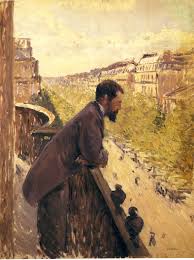
Man on Balcony (circa 1880), Gustave Caillebotte
Here we see solitude as a means to develop the objectivity that can be difficult to find when we are closely engaged with something or someone. Solitude, in offering us time to calm our emotions, reflect, and collect our thoughts, can help us return with a more objective and open frame of mind. And once we have had such experiences we can revisit them in our imagination in order to gain perspective. Jean Jacques Rousseau, in book III of his book Emile, explains:
“Robinson Crusoe on his island, deprived of the help of his fellow-men, without the means of carrying on the various arts, yet finding food, preserving his life, and procuring a certain amount of comfort; this is the thing to interest people of all ages, and it can be made attractive to children in all sorts of ways. We shall thus make a reality of that desert island which formerly served as an illustration. The condition, I confess, is not that of a social being, nor is it in all probability Emile’s own condition, but he should use it as a standard of comparison for all other conditions. The surest way to raise him above prejudice and to base his judgments on the true relations of things, is to put him in the place of a solitary man, and to judge all things as they would be judged by such a man in relation to their own utility.”
Robert B. Talisse’s book Civic Solitude: Why Democracy Needs Distance is a perceptive account of how the increased objectivity of solitude can be translated into the civic realm as a means to combating wide-spread group and political polarization. An Amazon description is as follows: “Drawing on extensive research about polarization and partisanship, Talisse argues that certain core democratic capacities can be cultivated only at a distance from the political fray. If we are to meet the responsibilities of democratic citizenship, we must occasionally step away from our allies and opponents alike. We can perform this self-work only in secluded settings where we can engage in civic reflection that is not prepackaged in the idiom of our political divides, allowing us to contemplate political circumstances that are not our own.”

Of course these potential social and political benefits of solitude shouldn’t lead us to overlook how real or imagined solitude can offer us a means to seeing ourselves more objectively as well. And this higher degree of objectivity can contribute to a higher degree of individuality. After all, knowing oneself and individuality seem to be inseparable. Thus we can draw a connection between our first and second reason in defense of Nietzsche’s claim. If this is the case then any pedagogy seeking to cultivate a higher degree objectivity should incorporate solitude in some way.
For a third reason why solitude can be integral to education go here.
For a interesting interview with Talisse on the Philosophy Bites podcast go here.