258. Immanuel Kant on Forms of Beauty as English Gardens
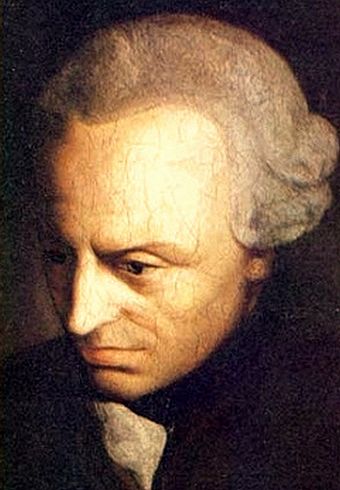
Immanuel Kant (1724-1804)
Introduction
There are two common positions when it comes to judgments of beauty. On the one hand, many think that beauty is “in the eye of the beholder”: a matter of opinion with no objective reference whatsoever. On the other hand, some think beauty is an objective property of things that exist independent of beholders. However, the philosopher Immanuel Kant offers us a third option in his influential book on aesthetics Critique of the Power of Judgment (1790). Kant claims judgments of beauty are aesthetic which means they are judgments about the pleasure we feel in relation to certain things. This means that beauty will be primarily subjective. However, to this subjective side he adds certain objective conditions that trigger our common sense or faculty of taste to feel this pleasure. Thus for him judgments of beauty are the outcome of both subjective and objective factors.
In this essay (about 30 min. reading time) I want to present this alternative which, once understood, opens up the surprising possibility that beauty can be a matter of subjective feelings which are nonetheless universal. This offers us a way to take something from, on the one hand, the empiricist tradition of aesthetics (represented by David Hume, Francis Hutcheson and Edmund Burke) which maintained judgments of taste consist in feeling without cognitive content and, on the other hand, the rationalist tradition (represented by Alexander Baumgarten, Gottfried Leibniz, and Georg Friedrich Meier) which maintained judgments of taste consist in the cognition of certain objective properties in an object. I will then explore in some detail one of the objective conditions Kant briefly mentions, namely, that forms of beauty must be inexhaustibly interesting and always new to us. Such forms, he suggests, are akin to an English garden whose minimal imposition of order supports, rather than removes, the wildness of nature and makes it accessible as a whole to our imagination. What is so intriguing about this condition is that it offers a criterion for understanding beauty which, rather than reducing beauty to a determinate concept or rule, allows for a potentially infinite diversity of forms. And it offers us an inspiring vision of beauty as a force of vitality and renewal that has profound implications for our lives. However, Kant’s theory is not without its problems and so I consider ten lines of questioning we can bring against it. I conclude by suggesting that Kant’s theory is, for the most part, defensible but is best taken as one very important way we can think about beauty among others.
Let’s begin with a look at the four aspects, or “moments” as Kant calls them, that go into making judgments of the beautiful. Take note that in his work the order of presenting these aspects is slightly different (his number 3 is my number 4). I made the change to exhibit with more clarity the passage from the subjective side of judgments of beauty to the objective side.
Kant’s Judgments of Beauty: A Brief Overview
(1) Judgments of the beautiful must be disinterested (see Division 1, Book 1, sections 1-5)
This means that, while we do experience pleasurable feelings in making a judgment that something is beautiful, this pleasure is neither the outcome of, nor gives rise to, a desire for the thing. When we make an interested judgment, we desire something because it is useful, morally good, or true. But in a disinterested judgment these desires disappear and we give our full attention to something’s form for its own sake. One way to think about this is to say we do not judge x to be beautiful because it pleases our desires (as we might when we see a table full of tasty food) but rather it pleases us because we judge it to be beautiful (as we might when we see a still life painting of a table full of tasty food).

Jan van Kessel, Still-Life on a Table with Fruit and Flowers
(2) Judgments of the beautiful must be universal (see Division 1, Book 1, sections 6-9)
In section 17 Kant declares “There can be no objective rule of taste which shall determine by means of concepts what is beautiful. For every judgement from this source is aesthetical; i.e. the feeling of the subject, and not a concept of the Object, is its determining ground. To seek for a principle of taste which shall furnish, by means of definite concepts, a universal criterion of the beautiful, is fruitless trouble; because what is sought is impossible and self-contradictory” (translation by J.H. Bernard). But, despite the fact that our judgments of beauty are about our feelings, we don’t think our judgments are particular to us and us alone. After all, we try to convince others that they should feel the same. Thus if we judge something to be beautiful we think it should judged universally so: beautiful for everyone, everywhere, at all times. If one doesn’t think this then one is not, for Kant, making a judgment of the beautiful but a judgment about what is, as he says, “personally agreeable.” It is important to note that Kant is not saying people do, in fact, agree about what is beautiful. He is only saying that judgments of the beautiful necessarily entail the belief that others should feel as we do. And this prescriptive dimension, while it doesn’t admit of proof since we have no rules, gives rise to critique as we point others to experience the particular things we find to be beautiful which can then be discussed.

I took this photo of the Austrian Alps which struck me as beautiful. Therefore I think you should judge it to be beautiful as well!
(3) Judgments of the beautiful are necessary judgments (see Division 1, Book 1, sections 18-22; also sections 38-40)
Kant says judgments of the beautiful are also marked by a kind of necessity which, rather than being a function of logical or physical law, is “exemplary”: our judgments about singular things themselves exemplify it insofar as we think it is necessary others should agree with us. But what makes sense of this necessity if aesthetic judgments are about our feelings? Well, in his Critique of Pure Reason Kant argues that our minds are not passive receivers of sense data but actively structure incoming data in accordance with twelve “categories of the understanding.” For example, he argues that all humans experience the world as a system of cause and effect relations because our mind structures events in terms of the category of cause and effect. If our minds didn’t organize sense data in accordance with the categories then we wouldn’t have experiences at all. Now, in his Critique of Judgment the “common sense” (sensus communis), which he also refers to as the faculty of taste, plays a similar role. It is the capacity to judge by feeling rather than concepts. And this capacity, as he explains in section 40, allows our reflection “to compare its judgement with the collective Reason of humanity, and thus to escape the illusion arising from the private conditions that could be so easily taken for objective, which would injuriously affect the judgement. This is done by comparing our judgement with the possible rather than the actual judgements of others, and by putting ourselves in the place of any other man, by abstracting from the limitations which contingently attach to our own judgement.” Without this common sense we couldn’t expect others to necessarily agree with our universal judgments of the beautiful upon adopting a disinterested attitude in the presence of certain kinds of forms. Indeed, we couldn’t even communicate our judgments since the common sense is “the necessary condition of the universal communicability of our knowledge” (section 20). Therefore our common sense makes judgments of beauty possible by opening us up to a critical community of others who can judge beauty as well. And this reveals its socializing and humanizing power:
“If we admit the impulse to society as natural to man, and his fitness for it, and his propensity towards it, i.e. sociability, as a requisite for man as a being destined for society, and so as a property belonging to humanity, we cannot escape from regarding taste as a faculty for judging everything in respect of which we can communicate our feeling to all other men, and so as a means of furthering that which every one’s natural inclination desires” (section 40).
And, as we will see below, Kant argues we cannot escape from thinking of the common sense as an indeterminate concept of a “supersensible substrate” which lies beyond sense experience and indeed the physical world.

Caspar David Friedrich, Two Men Contemplating the Moon (ca. 1825-30) A shared perception of beauty made possible by our common sense?
(4) Judgments of the beautiful must be in response to something that has the form of purposiveness without the presentation of a definite internal or external purpose (see Division 1, Book 1, sections 10-17)
But what kinds of forms will our common sense or faculty of taste judge as beautiful? To approach Kant’s answer we have to grasp a few distinctions between types of purpose, concepts, and judgments.
Typically an object is understood to have a purpose if it is made according to some conception of a definite external end for which it will be used. For example, a car is constructed according to certain concepts, some of which include the ability to get people somewhere, protect them in certain ways, give them pleasure, and so on. We can also conceive of a definite purpose internal to something that sets a criterion for its perfection such as the purpose of a colt thoroughbred to flourish into a fast and agile horse. In the normal perception of objects, our imagination is constrained by such “concepts of the understanding.” These are “determinate concepts” or rules which allow us to make “determine judgments” in which we start with a clear concept of something and judge a particular thing to fall under that concept (as we do when we judge a particular vehicle to be a car and a particular horse to be a thoroughbred). In section 16 Kant claims judgments about the beauty of things with determinate concepts are “impure” or “dependent beauties.”
But we also make judgments about “pure” or “vague” or “free beauties” which do not presuppose a determinate concept and are not the outcome of determinate judgments. These are “reflective judgments” in which we start with a particular thing and then try and find an adequate concept for it. In such judgments the imagination and understanding are in a state of “free play” or “free harmony” with each other since there are no determinate concepts to follow. Here we can think of an encounter with a beautiful landscape or painting in which we freely follow the contours, discover relationships among the shapes, see from new perspectives, and appreciate how it all fits together without being determined in our efforts by determinate concepts. Or we can think of engaging in such free play in response to certain birds and shells as Kant suggests in section 16: “Many birds (such as the parrot, the humming bird, the bird of paradise), and many sea shells are beauties in themselves, which do not belong to any object determined in respect of its purpose by concepts, but please freely and in themselves.”

Rufous-tailed Hummingbird in flight, feeding on flower in Ecuador (photo: Andy Morffew)
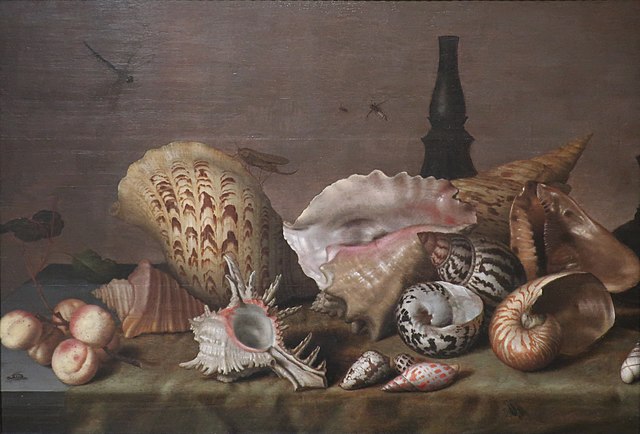
Balthasar van der Ast, Sea Shells (1630-1650)
We contemplate purpose in these things but in an open, searching, and indefinite manner. This contemplation “strengthens and reproduces itself” and “keeps us lingering” on the representation.
And it is this kind of self-perpetuating and free-floating purpose Kant calls “the form purposiveness” in us.
But given that this form manifests in the context of an experience of something, it makes sense that Kant thinks we can observe it both in us and in the objects we take to be beautiful: “Thus we can at least observe a purposiveness according to form, without basing it on a [determinate] purpose…and we can notice it in objects, although only by reflection.”
And to say that something has the form of purposiveness is to say its properties give rise to a free play of the imagination and understanding in us.
Indeed, it seems as if they were designed to do so without us being able to refer to any determinate internal or external concept. And we take pleasure in how well our imagination and understanding seem to fit with what we observe. But, as Kant stresses in section 37, this is not some kind of self-centered pleasure contingently grounded in empirical facts, personal tastes, cultural differences, etc. Rather, it is a “universally valid pleasure,” one we attribute “necessarily to every one” which, because it finds its source in our shared faculties, can be known a priori, that is, independent of any observation through the senses. And, as Paul Crowther points out in his book The Kantian Aesthetic (Oxford, 2010), there is something else that makes this pleasure special:
“And the ‘pure’ aesthetic pleasure arising from judgements of beauty has a highly distinctive status. For in so far as it is pleasure, it is bound up with our sensible animal nature, but in so far as it is grounded in the harmony of subjective cognitive capacities, it has some connection with conditions involved in the exercise of freedom….By means of it, an aspect of our sensible nature finds some harmony with our existence as free rational beings” (68-69).
Kant is well known for maintaining, on the one hand, that our bodies are part of a determined system of nature and, on the other hand, that we are rational beings with free will. But how can these two positions be reconciled? It is hard to see how if we only employ our reason. But when we judge nature to be beautiful we feel as if there is a reconciliation between freedom and necessity. In the experience of beauty we appear to overcome our alienation from the world and feel at home.
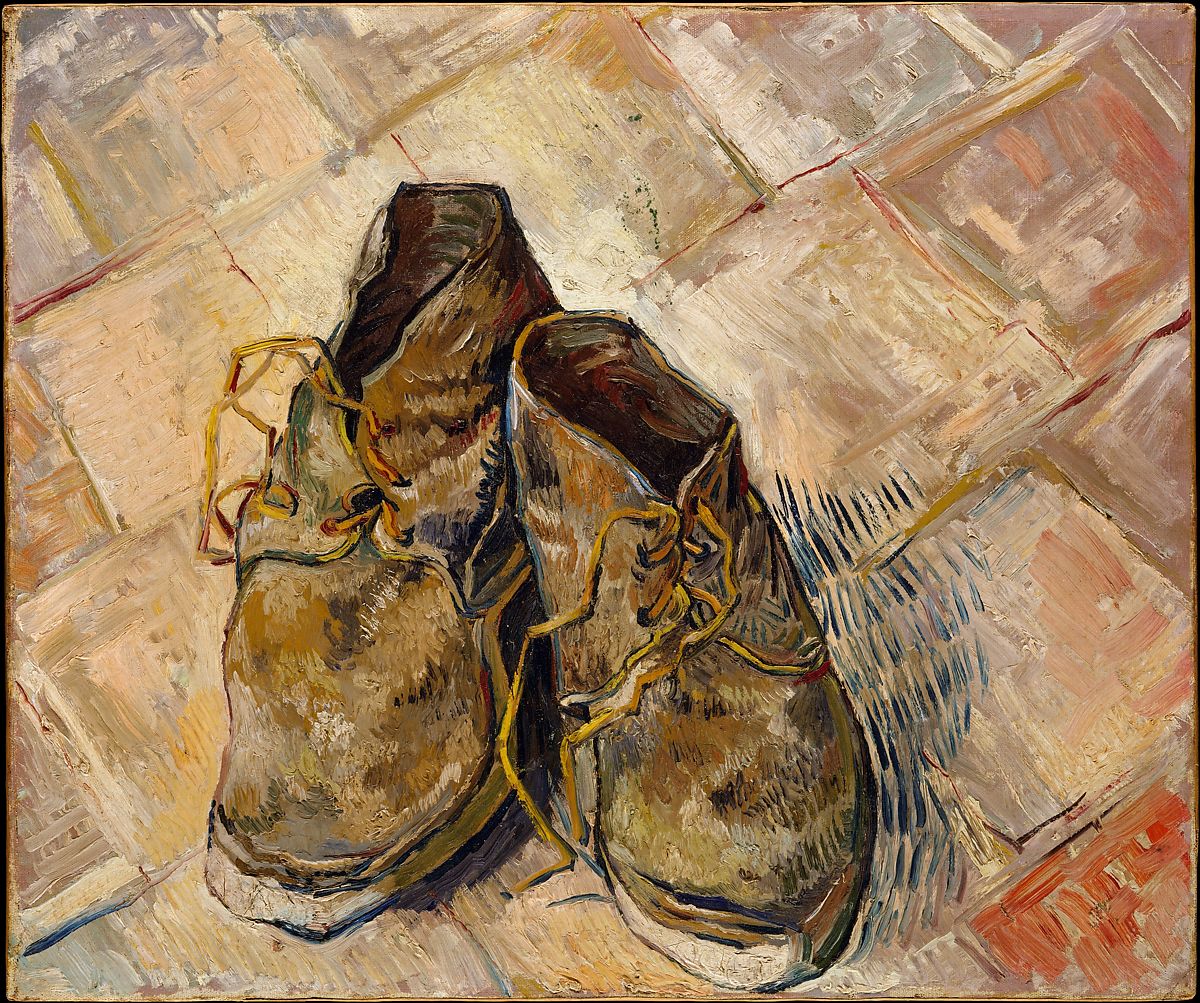
Van Gogh’s Shoes (1888) We are not thinking of shoes to be used nor are we seeing them as specimens of perfectly actualized form. And yet Van Gogh’s work appears to have the “form of purposiveness” insofar as it triggers a free play of the imagination and understanding in us.
Forms of Beauty as English Gardens
But what else can we say about these forms that give rise to this distinctive pleasure in us? Well, later in his discussion of the sublime Kant notes that the beautiful “concerns the form of the object, which consists in [the object’s] being bounded.” And in section 14 he emphasizes the importance of design and composition when he points out that tones and colors, rather than being beautiful in themselves, serve as a means to appreciating the structures in which they reside:
“Every form of the objects of sense (both of external sense and also mediately of internal) is either figure or play. In the latter case it is either play of figures (in space, viz. pantomime and dancing), or the mere play of sensations (in time). The charm of colours or of the pleasant tones of an instrument may be added; but the design in the first case and the composition in the second constitute the proper object of the pure judgement of taste.”
But to say we need a bounded whole of composed or designed elements isn’t that helpful since there appear to be plenty of non-beautiful things that satisfy this criterion. Luckily Kant suggests another condition in these remarkable passages from the section “General Comment of the First Division of the Analytic”:
“But where all that is intended is the maintenance of a free play of the powers of representation…in ornamental gardens, in the decoration of rooms, in all kinds of furniture that shows good taste, etc., regularity in the shape of constraint is to be avoided as far as possible. Thus English taste in gardens, and fantastic taste in furniture, push the freedom of imagination to the verge of what is grotesque the idea being that in this divorce from all constraint of rules the precise instance is being afforded where taste can exhibit its perfection in projects of the imagination to the fullest extent. All stiff regularity (such as borders on mathematical regularity) is inherently repugnant to taste, in that the contemplation of it affords us no lasting entertainment. Indeed, where it has neither cognition nor some definite practical end expressly in view, we get heartily tired of it. On the other hand, anything that gives the imagination scope for unstudied and final play is always fresh to us. We do not grow to hate the very sight of it. Marsden, in his description of Sumatra, observes that the free beauties of nature so surround the beholder on all sides that they cease to have much attraction for him. On the other hand he found a pepper garden full of charm, on coming across it in mid–forest with its rows of parallel stakes on which the plant twines itself. From all this he infers that wild, and in its appearance quite irregular beauty, is only pleasing as a change to one whose eyes have become surfeited with regular beauty. But he need only have made the experiment of passing one day in his pepper garden to realize that once the regularity has enabled the understanding to put itself in accord with the order that is the constant requirement, instead of the object diverting him any longer, it imposes an irksome constraint upon the imagination: whereas nature subject to no constraint of artificial rules, and lavish, as it there is, in its luxuriant variety can supply constant food for his taste.”

These passages reveal that beautiful things, insofar as they are not formulaic, regular, derivative, predictable, and so on, always appear new and inexhaustibly interesting to us. True, we don’t want excessive irregularity or something “grotesque” which, in his Observations on the Feeling of the Beautiful and the Sublime (Cambridge, 2011), Kant defines as follows: “Unnatural things, in so far as the sublime is thereby intended, even if little or none of it is actually found, are grotesqueries” (21). But irregularities integrated to the verge of excess can offer an occasion for taste “to exhibit its perfection in projects of the imagination to the fullest extent.” As he says, this can happen in relation to the “fantastic taste in furniture” which we might find in rococo works such as this French chair (1754-56) in the Metropolitan Museum of Art:



Or this desk by Bernard II van Risamburgh displayed in the Münchner Residenz, Munich, Germany (1737):

But I want to focus on his far more illuminating example of an English garden since, as he points out in section 17, the concept involved in “a beautiful garden” is “not sufficiently determined and fixed” so that “its purposiveness is nearly as free as in the case of vague beauty.” A beautiful garden is not conceptually indeterminate (like a beautiful natural landscape with no definite concept) and yet not completely determinate either (like a hammer with a definite concept). So, while it is a human construction, it is “nearly as free” as pure beauty given its ability to “supply constant food” for our taste. And insofar as gardens have boundaries, are designed, and perceived to be indefinitely purposive they meet the other conditions Kant specifies for beautiful form as well. All these traits suggest English gardens may help us to better understand the form of purposiveness in things without imposing a determinate concept or rule.
Now, an English garden, in seeking to impose just enough order on wild nature to make it accessible to our imagination as integrated, differs from a French garden which expresses a complete control of nature with its strict symmetry, geometry, patterned beds, and elaborately crafted topiaries. Regarding the latter I think of my trip to the gardens of Versailles in France where I encountered some very impressive feats of symmetry indeed:
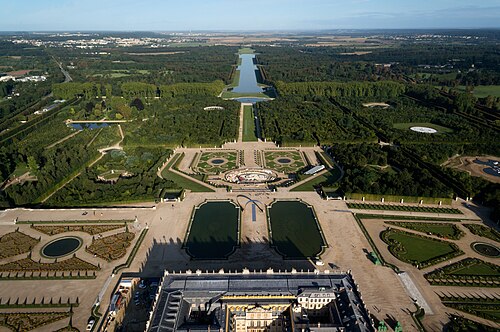
Jardins du château de Versailles (photo by ToucanWings)
Here is André Le Nôtre’s plan of the gardens from 1746 which shows the rigorous geometry involved:
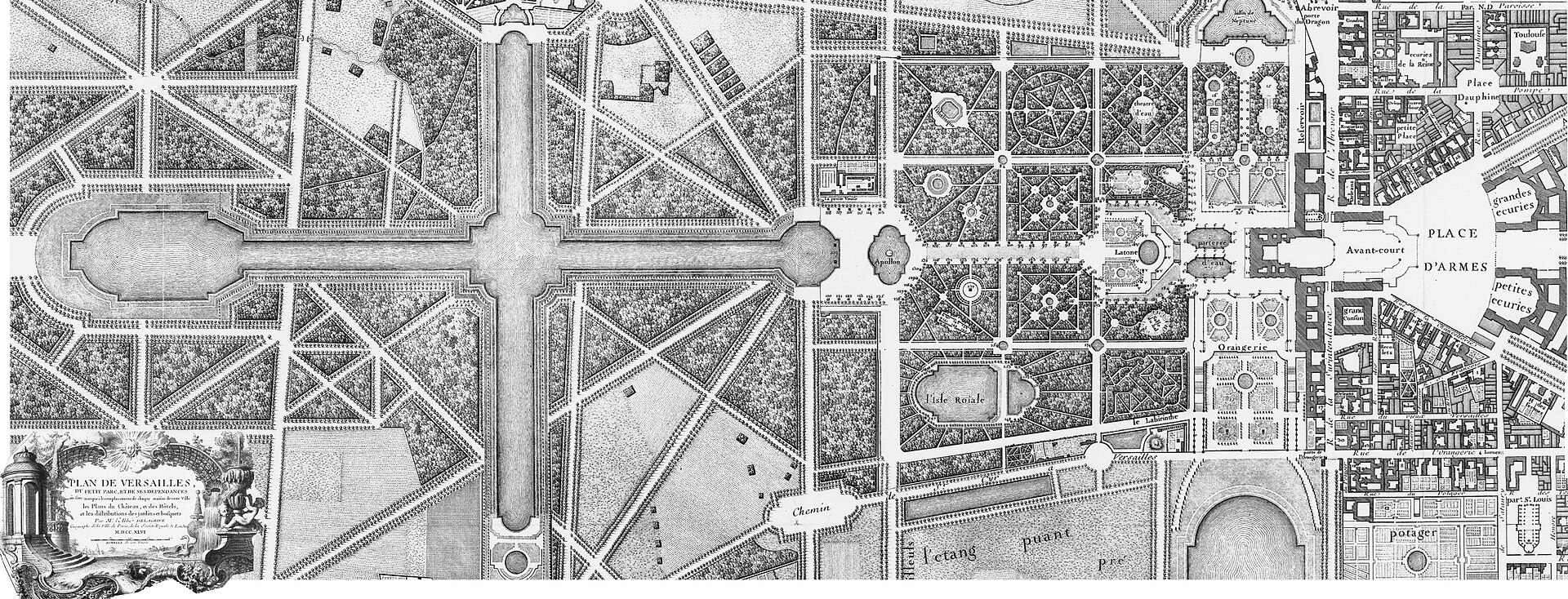
Of course, these highly structured gardens are incredible. But would they always be “fresh to us”? I’m not so sure. On the other hand, wouldn’t a stroll in this English garden activate our common sense and generate a vitalizing free play of the imagination every time?
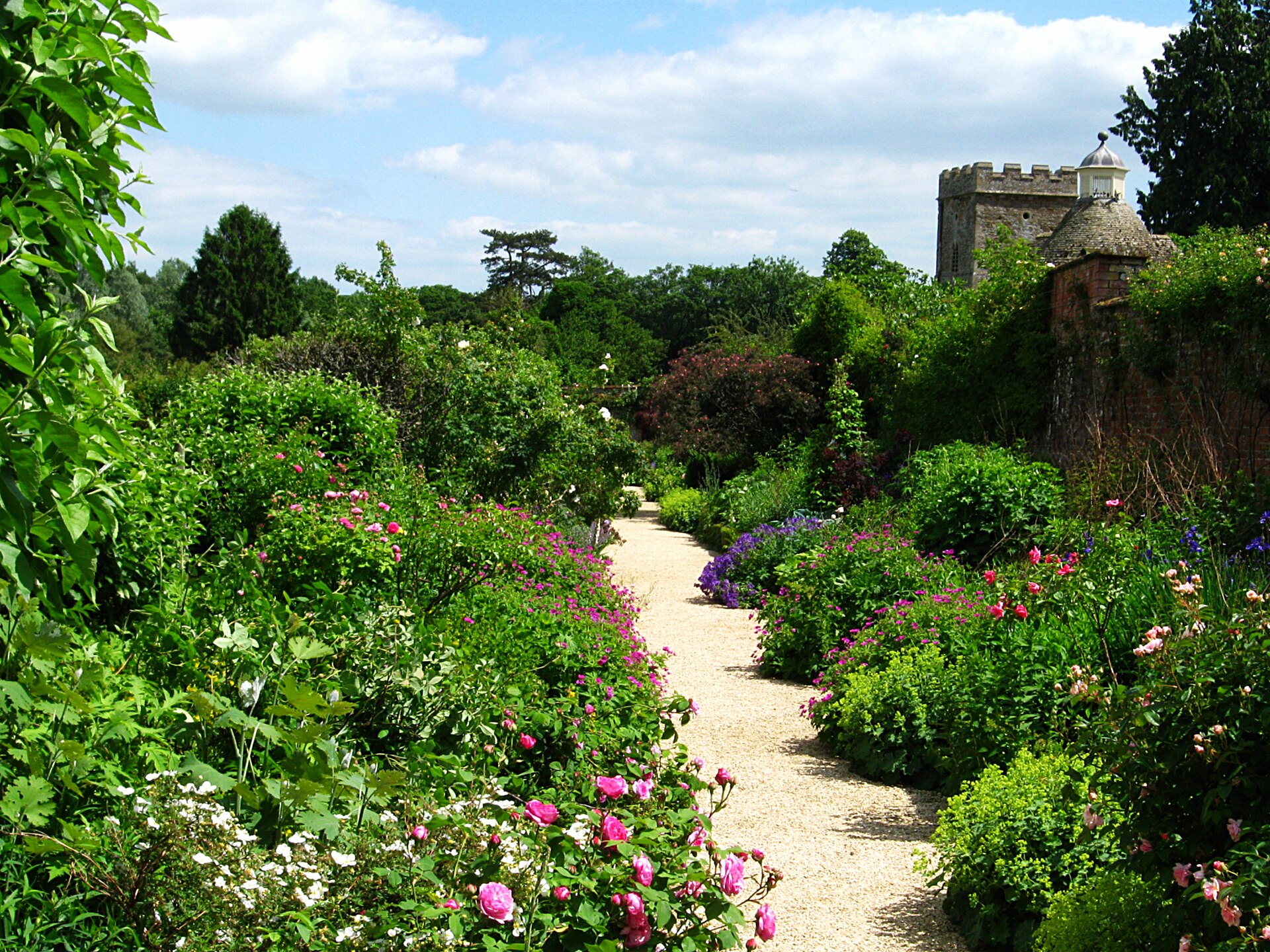
Rousham House Gardens in Oxfordshire (photo by Jason Ballard)
I certainly felt like the famous English Garden in Munich could sustain my interest forever as I strolled through it. Note the man-made waterfall created in 1815:
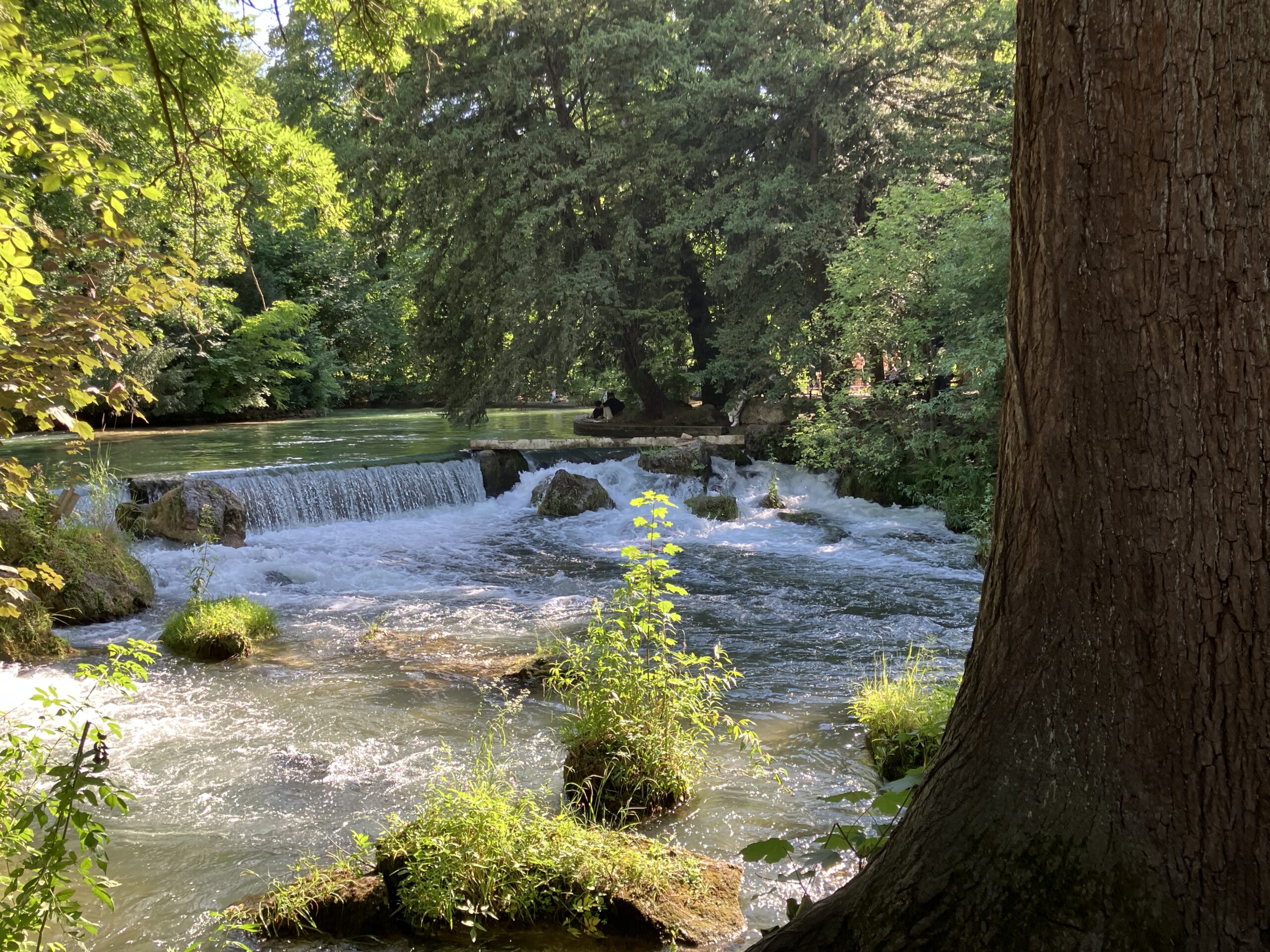
The Englischer Garten in Munich, Germany (photo by Dwight Goodyear)
Another classic example is the Stourhead House gardens in Wiltshire designed by Henry Hoare II between 1741 and 1780:

Palladian bridge and Pantheon at Stourhead (photo by Hamburg103a)
Japanese gardens employ a similar approach of imposing only enough order to allow nature to appear in its rich diversity and asymmetry. For example:
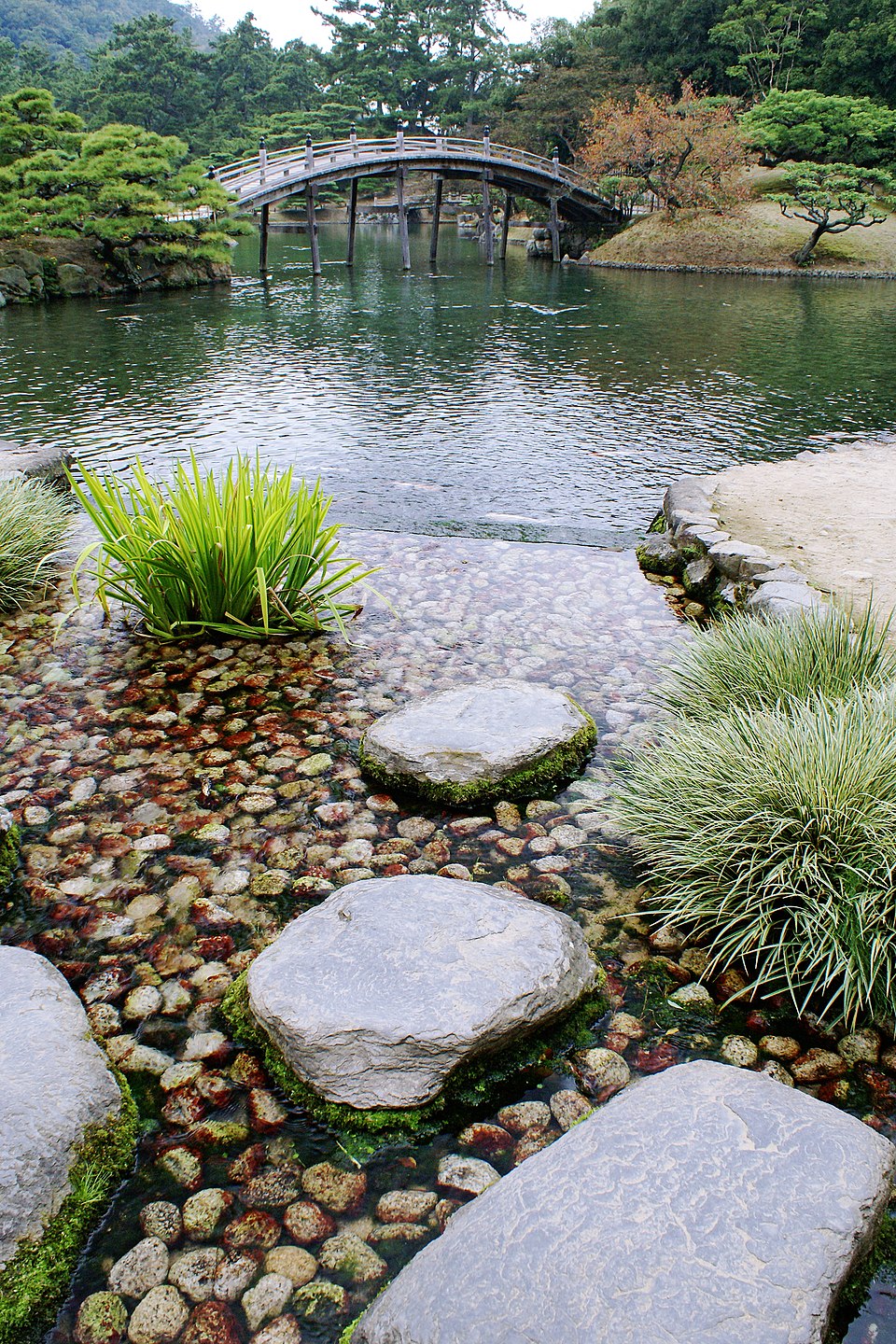
Ritsurin Garden in Takamatsu, Kagawa Prefecture, Japan (Photo by 663highland)


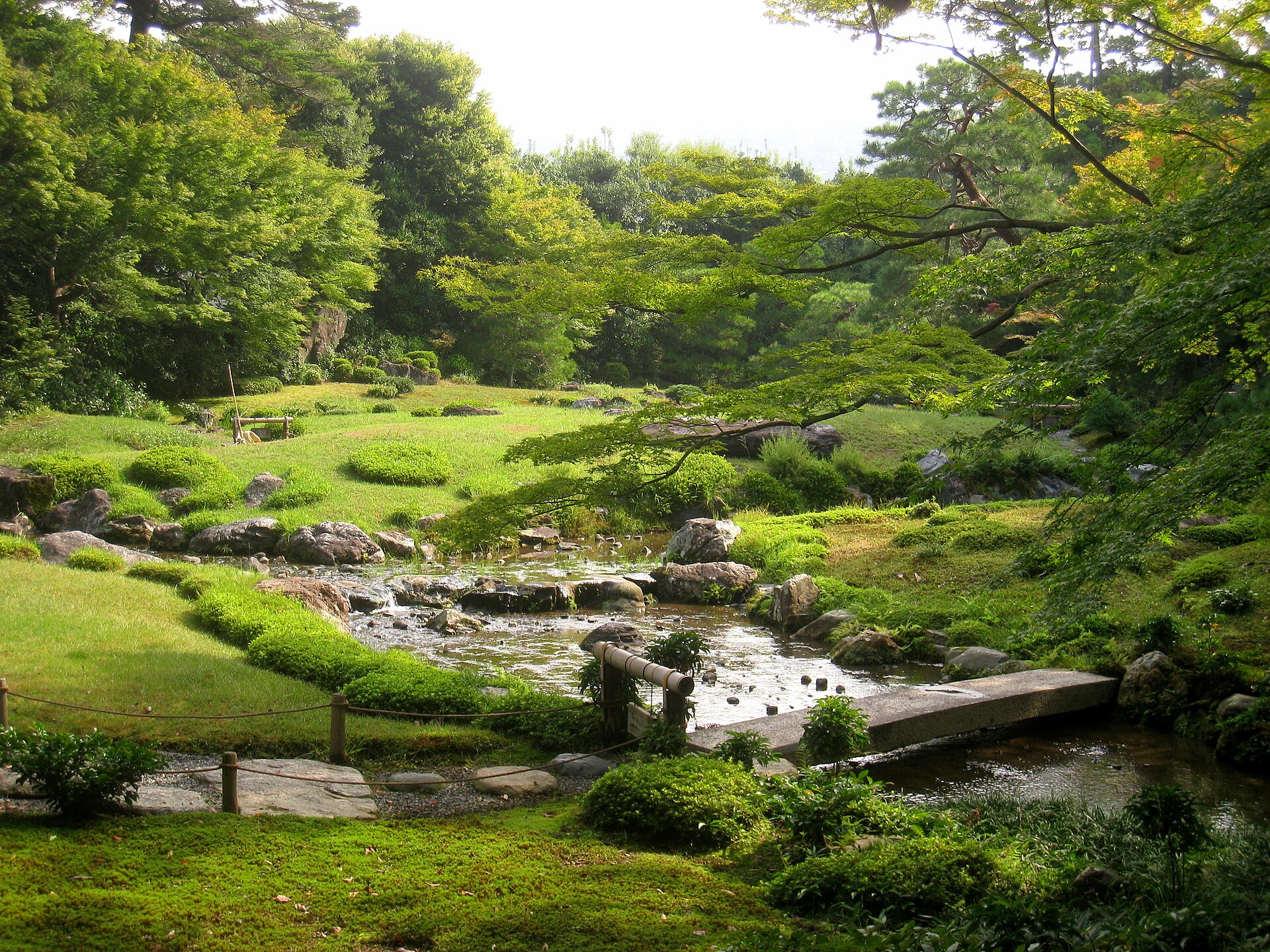
Murin-an, 8 Nanzenji-kusakawa-cho, Sakyo-ku, Kyoto, Japan (photo by Daderot)
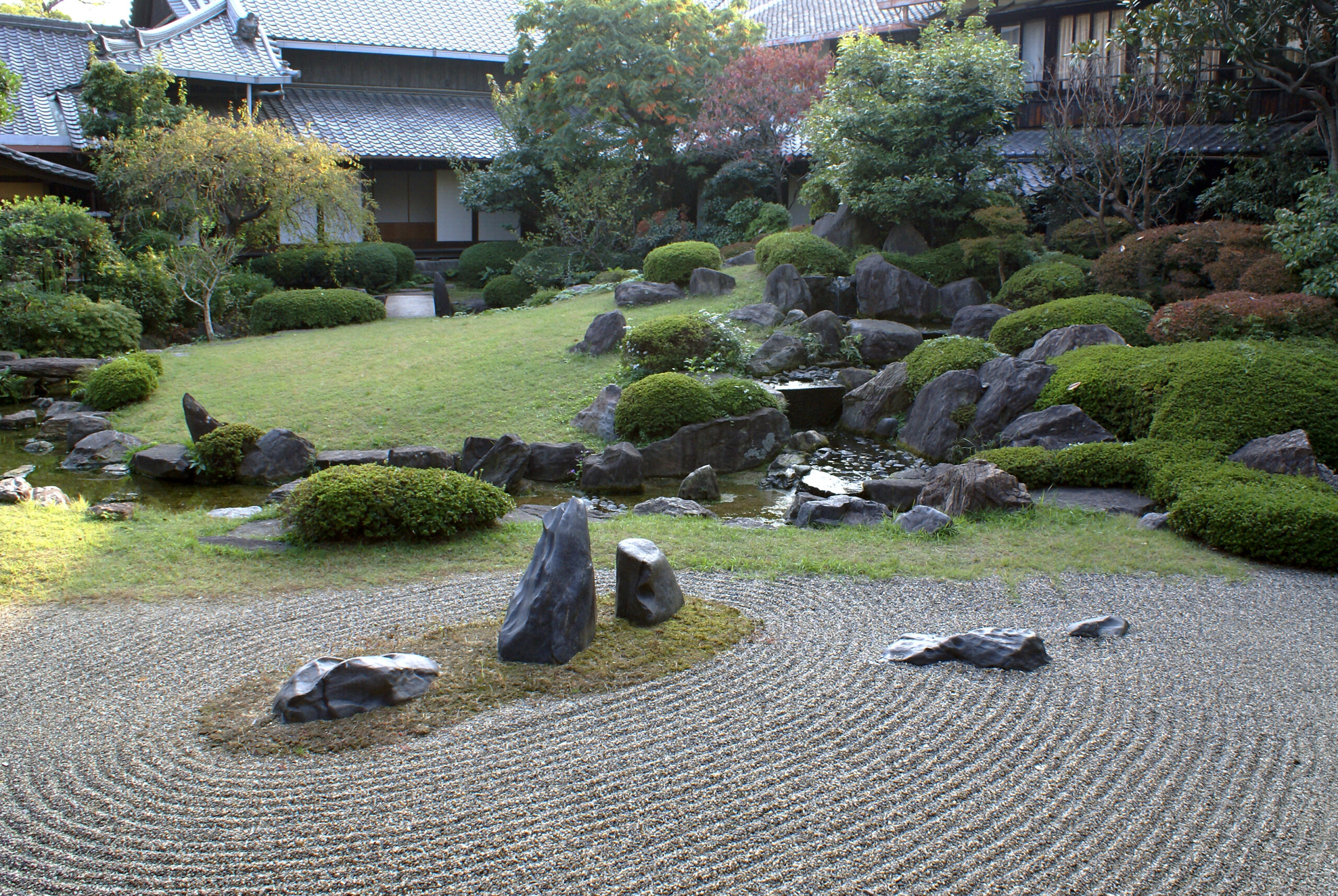
Shitennō-ji Honbo Garden in Osaka, Osaka prefecture, Japan (photo by 663highland)
Gardens are, of course, quite diverse as are the categorizations of them. So I think Kant’s use of English gardens is less about labels and more about the insight behind it: that a crucial formal condition for stimulating a free play of the imagination is having an inexhaustibly rich diversity of irregular factors presented with a degree of supporting, rather than overpowering, order. I think this condition helps explain why some compositions or designs which are bounded wholes strike us as beautiful and some do not. I also think this condition can help explain why beautiful things are so interesting to us for their own sake: the richness of their forms warrants endless attention unlike the derivative, predicable, cliché-ridden things of our experience that quickly bore us.
Now Kant emphasizes nature in his analysis of beauty although human art can be beautiful too if, rather than emerging from imitation of something in accordance with rules, it is created without a conscious application of rules at all. Such original creation is the work of “genius” which is a function of nature’s power through which rules are given to the artist rather than followed: “Genius is the talent (or natural gift) which gives the rule to Art.” Such a rule becomes “exemplary” not because it is imitated but because it inspires other geniuses to create their own original works. And such works will have “the look of nature even though we are conscious of it as art” (section 45). One way to understand this “look” is in terms of the foregoing metaphor of an English garden. For example, we might consider works which capture nature’s vast diversity within the boundaries of a well-defined yet unobtrusive composition such as Bentheim Castle:
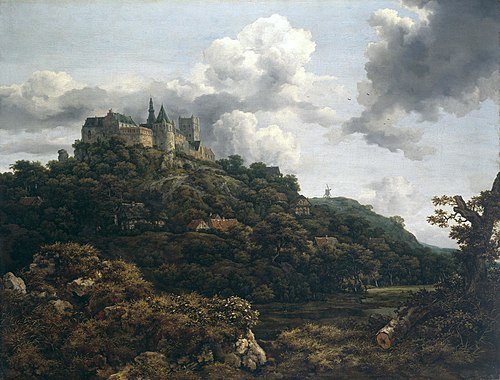
Jacob Isaakszoon van Ruisdael, Bentheim Castle (1653)
But we might also turn to rule-giving rather than rule-following works of genius in modern art which, at first glance, have very little to do with gardens. For example, I find this glass cube by Larry Bell which, as he says, “reflects, absorbs, and transmits light at the same time,” to be a trigger for the feeling of beauty in me. Bell is sometimes referred to as a minimalist and that can be true given the minimal materials involved. But the effects of light that flow from the materials, which are ever changing and unique to every person who encounters them, have a maximal look of nature that can even make us forget we are looking at a cube:

Larry Bell, Untitled Cube (1993)
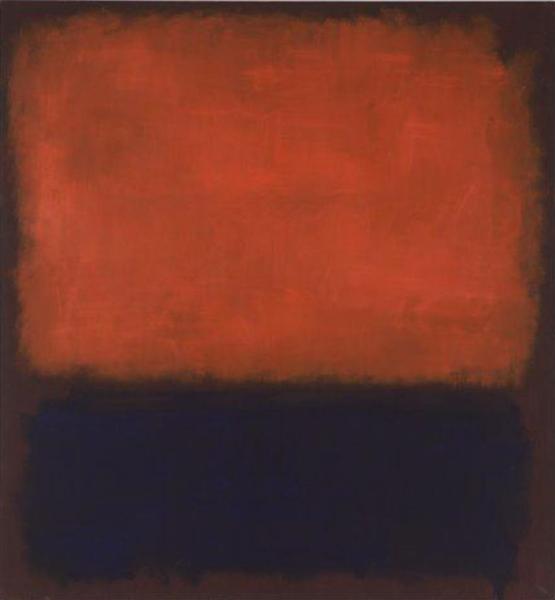
I think many of Rothko’s works, such as painting No. 14 from 1960 with its throbbing color fields full of nuances, have a look of nature as well:
And Pollock’s Autumn Rhythm has the look as it expresses the wild rhythm of nature within a bounded whole marked by a consistent color palette:
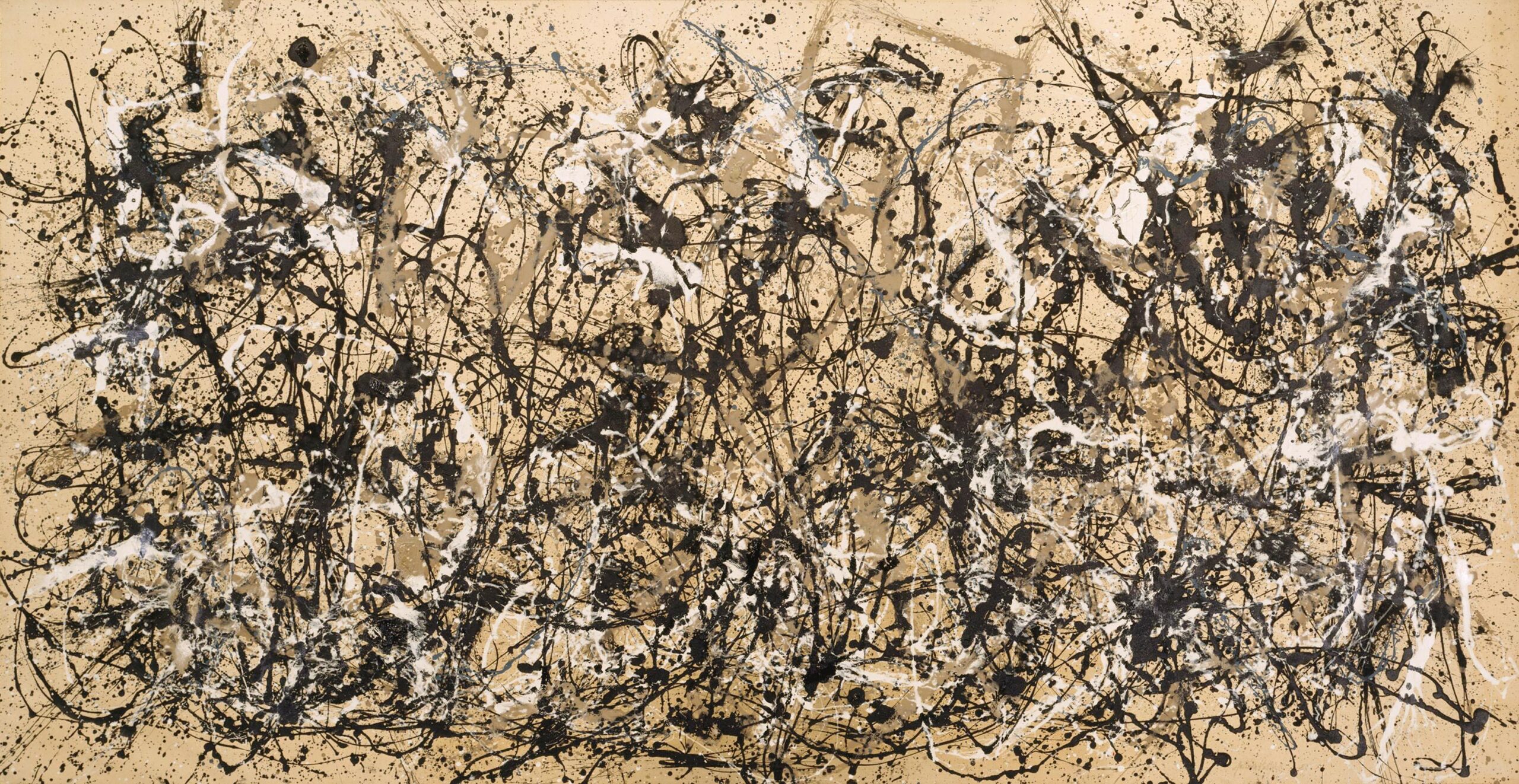
Jackson Pollock, Autumn Rhythm (Number 30), 1950
Of course, we need not limit ourselves to the visual arts. For Kant notes that pure beauty can be found “in music phantasies (i.e. pieces without any theme), and in fact all music without words.” For example, we can find musical analogues of Japanese gardens in the music of Tōru Takemitsu (1939-1996) who once said “I design gardens with music.” In his program notes to the 1994 premiere of A Bird Came Down the Walk (the title itself comes from a poem by Emily Dickinson entitled “In the Garden”) he elaborated: “You view a Japanese garden this way, circulating through it. It’s not a linear experience at all. It is circular…one always comes back. I write music by placing objects in my musical garden, just the way objects are placed in a Japanese garden…from gardens I’ve learnt the Japanese sense of timing and colour.” I think these points about circularity and return are important since they underscore the importance of a bounded whole in which a diversity of elements take place. In his work Fantasma/Cantos for clarinet and orchestra, part of his “garden series” along with Dream/Window and Spirit Garden, he imagined the orchestra as a Japanese garden designed for a circular walk represented by the clarinet: “As you enter the garden, you experience the stones, trees, water, and foliage from an initial vantage point. Moving along the circular path, you begin to glimpse the same elements of the garden from different angles until reaching a kind of halfway moment of calm and balance before proceeding again round the garden, ending at the very same starting point which is exactly the beginning yet now, seen again with the experience of the circular path, feels suddenly changed.” And his work Arc for Piano and Orchestra employs the same approach since “The solo piano assumes the role of an observer strolling through the garden. In the same way that plants and sand exist in a given space in their own time, changing with the climate and seasons…so do musical aspects change in this piece.” For some other examples of these ideas at work, see his A Flock Descends into the Pentagonal Garden, In an Autumn Garden, and Garden Rain whose rigorous compositional structures never prevent the music from having a unpredictable and irregular “look of nature.”
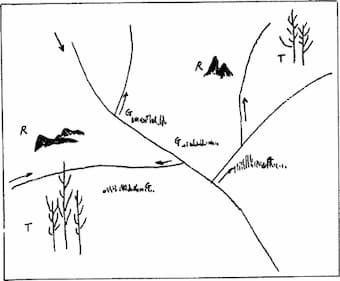
A sketch by Takemitsu showing the garden-like structure of his
Arc For Piano And Orchestra
Naturally all these examples are open to discussion and we can put forth plenty of others for consideration. The key is to grasp the conceptual meaning of Kant’s English garden metaphor so we can use it as a versatile and experimental criterion to identify and evaluate objective properties in relation to our judgments of beauty.
However, we need to keep in mind that this objective condition as well the others which it enriches – being a bounded whole of composed or designed parts that is perceived to be indefinitely purposive by us – are not “determinate concepts” which set universal rules and enable us to judge something as beautiful without directly experiencing it. The search for such concepts is, as we saw, a “fruitless trouble; because what is sought is impossible and self-contradictory.” Aesthetic judgments are therefore not “determine judgments” but “reflective judgments” in which we start with a particular thing and then try and find an adequate concept for it. The conditions we’ve discussed appear to be the fruits of such reflective judgments which, while providing some understanding, fall short of being determinate rules we can scientifically apply. This, however, appears to be a boon since they allow for a potentially infinite variety of beauteous forms and can be supplemented by other criteria.
Questions for Further Inquiry
Kant’s incredibly nuanced account is certainly as impressive as it is influential. It also raises some questions. Here are a few we can ask.
(1) Should judgments of the beautiful arise only in response to the formal properties of a thing? You may like the color green and I may not like it; you may like the sound of cellos and I may not like it. But for Kant, colors and sounds will not be what we are reacting to in our judgments of the beautiful; we will only be reacting to the formal properties of a painting or a piece of music: the shapes, the structures, the proportions, the ratios, etc. But this position of seeing colors not as beautiful in themselves but “because they make the form more exactly, definitely, and completely intuitible” seems too limited for some. Think of someone you take to be beautiful. Isn’t part of his or her beauty a matter of content as well as form?
(2) Kant, as we have seen, didn’t think judgments of beauty could be determinate judgments that place a particular thing under a universal concept or rule. But many claim we do have determinate concepts of beauty such as the golden ratio. Two quantities are in the golden ratio if the ratio between the sum of those quantities and the larger one is the same as the ratio between the larger one and the smaller: 1:1.618 (1:1.6180339887…). Some argue that faces that closely approximate the ratio will be considered beautiful by everyone despite, for example, their tastes in hair, skin, or eye color. So might there be determinate concepts of beauty after all?
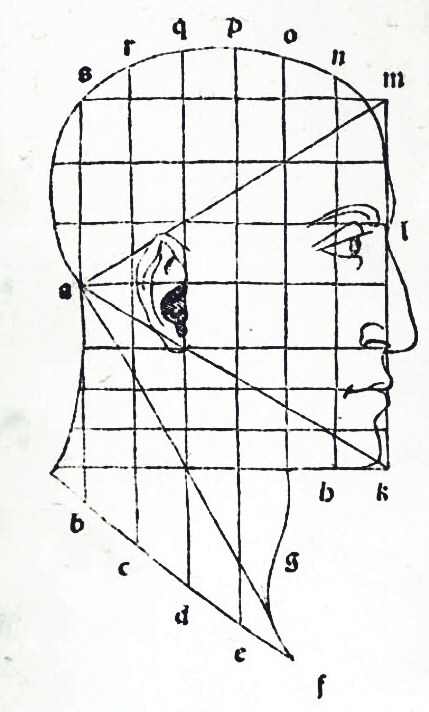
Leonardo da Vinci’s illustration of a human head. The Golden Ratio (approximately 1:1.618) is often held to be an objective measure of beauty. Kant would disagree!
(3) Are we really prepared to accept only objective conditions that trigger the experience of beauty in us? Why not believe that certain people, places, and things actually have beautiful properties? We can appreciate Kant’s effort to incorporate aspects of subjectivity and objectivity in his account. But why place beauty proper inside the subject as a feeling only? Why not include some aspect of real beauty on the objective side as well? Perhaps Kant, as Friedrich Nietzsche pointed out in his Genealogy of Morals (book 3, section 6), has focused far too much on the spectator: “All that I wish to emphasize is that Kant, just like other philosophers, instead of envisaging the æsthetic problem from the standpoint of the experiences of the artist (the creator), has only considered art and beauty from the standpoint of the spectator, and has thereby imperceptibly imported the spectator himself into the idea of the “beautiful”!”
(4) Is it really true that judgments of beauty must seek universal validity? Can we steer between, on the one hand, an aesthetic relativism with no objectivity and, on the other hand, a form of objectivity which always seeks universal agreement? Perhaps we can aspire to a form of situational objectivity according to which the parameters of situations set limits that reveal beauty is neither completely relative nor completely universal. Such a form might allow people to aspire to a community-based consensus rather than a universal one (the punk community, the avant-garde jazz community, the baroque music community, etc.). This might seem like a loss. But let us ask: should we really be aspiring towards universal agreement when it comes to beauty? What would the world be like if such agreement was completely realized? Wouldn’t it negate something important, namely, the diverse interpretations and ongoing critique that make aesthetics so interesting? Wouldn’t limited forms of objectivity be more consistent with a world of unique individuals with unique perspectives?
(5) And if we require a common sense or shared faculty of human nature to make sense of universality then isn’t that a problem given the sheer diversity, disagreement, and situational differences we see in the world? Well, later in Critique of Judgment (see especially section 57) Kant tries to overcome an “antinomy” or contradiction raised by his account: on the one hand, a judgment of beauty can have no determinate concept and, on the other hand, it requires a concept somewhere to make sense of our claims to universal agreement. In his struggle to resolve the antinomy he says we are “forced against our will to look beyond the sensible and to seek in the supersensible the point of union for all our a priori faculties; because no other expedient is left to make our Reason harmonious with itself.” The domain of the supersensible lies beyond the reach of the senses, empirical experience, and scientific knowledge. And what does Kant claim is in the supersensible to resolve the antinomy? The common sense as an indeterminate, rather than determinate, concept shared by all humans that makes universal aesthetic judgments possible. He then concludes: “In the Thesis we mean that the judgement of taste is not based upon determinate concepts; and in the Antithesis that the judgement of taste is based upon a concept, but an indeterminate one (viz. of the supersensible substrate of phenomena). Between these two there is no contradiction.”
This introduction of the supersensible strikes many as unnecessary and even outlandish. However, it might make sense if we think that a condition for the possibility of universal judgments is something truly universal not determined at all by our contingent, embodied circumstances. Moreover, we can argue that various aspects of judgments of the beautiful, such as purpose, reason, free play of possibilities, spontaneity, disinterest, semantic meaning, and inherent value, cannot be explained if we are just physical bodies determined by the purposeless, valueless, meaningless, and arational laws of nature and functional explanations of evolution. The common sense would then be something like a set of supersensible soul capacities that make universal aesthetic judgments possible. Finally, the introduction of the supersensible might add a religious dimension that helps account for the inexhaustibility of beauty. For example, in his book How Pictures Complete Us (Stanford, 2016) Paul Crowther notes, in his rich theological interpretation of visual art, that “the universe is not the outcome of a linear process, however much it appears that way from a finite perspective. We should see it, rather, as emergent from the divine essence.” He then links this emergence to visual art: “Tracing the emergence of this three-dimensional meaning from the planar base is a dynamic and inexhaustible activity. In other words, the open character of emergent meaning of the pictoral artwork gives its created ontology a symbolic kinship with God’s creation and sustaining of the universe” (153). And something similar could be said for the beauty of nature if God designed and sustains it.
Since I believe in the soul (go here for my preferred argument) and think there are rationally acceptable arguments for God’s existence (go here for my preferred argument) I am sympathetic to Kant’s notion of the supersensible. But for those who deny the soul the notion would, as Daniel Herwitz points out in his book Aesthetics, “today make no sense at all” and be construed as “hocus-pocus” (67). He continues: “Without a Christian tradition of the ‘immortal soul’ to back him up, a tradition widely believed in his time, the claim [that the common sense is supersensible] would be absurd” (67). And even if we have a common sense as Kant construes it we can ask: how do we know we are using it in the same way? Kant himself admits that judgments of taste are fallible and so we can never be sure we are adequately disinterested. Naturally, this leads us to seek confirmation by having others experience what we experience and engage in dialogue about it. But how can we escape fallibility by seeking confirmation from others who are equally fallible? And if we can’t escape it then how can the common sense ground the necessity of aesthetic judgments? Such questions, as Richard J. Bernstein points out in his book Beyond Objectivism and Relativism (University of Pennsylvania Press, 1983), have serious consequences not just for aesthetics but for morality as well:
“Once we begin to question whether there is a common faculty of taste (a sensus communis), we are easily led down the path to relativism. And this is what did happen after Kant—so much so that today it is extraordinarily difficult to retrieve any idea of taste or aesthetic judgment that is more than the expression of personal preferences. Ironically (given Kant’s intentions), the same tendency has worked itself out with a vengeance with regards to all judgments of value, including moral judgments” (120).
(6) Is Kant’s claim that beauty “concerns the form of the object, which consists in being bounded” always true? To be sure, it is usually the sublime, rather than the beautiful, which strikes us as unbounded in force or quantity. But can’t these seemingly boundless stars be beautiful?

The Milky Way photographed by NASA’s Spitzer Space Telescope
(7) Anne Sheppard, in her book Aesthetics: An Introduction to the Philosophy of Art (Oxford, 1987), writes: “We have seen that Kant held both that aesthetic judgements claim universal validity and that there are no proofs which determine such judgements. I argued that he was fundamentally correct on both these points. What is lacking in Kant is any developed account of how the claim of aesthetic judgements to universal validity can be substantiated. I mentioned three problems in particular which Kant leaves unsolved: how aesthetic disputes may be resolved, how aesthetic judgements may be justified, and how aesthetic comparisons are possible” (76). Is this correct? Do the key aspects of Kant’s account – for example the indeterminate conditions of beautiful form, the free play of the imagination, the common sense, the rule-giving originality of genius, the impossibility to grasp beauty second hand by means of rules, and so on – fail to provide enough tools to engage in productive and non-arbitrary aesthetic critique?
(8) Kant concludes section 14 by saying that “Emotion, i.e. a sensation in which pleasantness is produced by means of a momentary checking and a consequent more powerful outflow of the vital force, does not belong at all to beauty.” But many would argue that the beauty of both nature and art is revealed in our emotional responses to them. To be sure, emotions can be idiosyncratic and may be hard to work into any aesthetics that seeks universality. But perhaps there are, as Tolstoy maintained in his book What is Art?, shared fundamental emotions grounded in human nature which, far from undermining universality, can be an indication of it.
(9) Is beautiful art really generated by geniuses with no rules at all? Isn’t that an extreme position which overlooks the role of rules as initial guides that can then be transcended? Must beautiful art be so radically original? Indeed, is there really anything completely original? Must art always completely dispense with imitation? Aren’t there beautiful works – bounded, well-composed and inexhaustibly interesting works that stimulate our faculties in a pleasurable manner – that are nonetheless imitations to a lesser or greater degree?
(10) Finally, we can raise plenty of questions about his criterion of disinterestedness in which concerns for truth, morality, and use-value are set aside. Is such a thing, as George Dickie argued in his essay “The Myth of the Aesthetic Attitude,” just a myth? Could it be, as Terry Eagleton argues in his book The Ideology of the Aesthetic (Blackwell, 1990, p. 3), something “inseparable from the construction of the of the dominant ideological forms of modern class-society, and indeed from a whole new form of human subjectivity appropriate to that social order”? In his Genealogy of Morals (book 3, section 6) Nietzsche wrote: “What is the meaning of a philosopher paying homage to ascetic ideals? We get now, at any rate, a first hint; he wishes to escape from a torture.” Could he be right? Could disinterestedness be nothing more than a psychological crutch to escape the world’s hardships? Doesn’t research from evolutionary psychology connect beauty to people, places, and things that support genetic replication? Was Freud right when, in part 2 of his Civilization and its Discontents, he observed that
“The science of aesthetics investigates the conditions under which things are felt as beautiful, but it has been unable to give any explanation of the nature and origin of beauty, and, as usually happens, lack of success is concealed beneath a flood of resounding and empty words. Psycho-analysis, unfortunately, has scarcely anything to say about beauty either. All that seems certain is its derivation from the field of sexual feeling. The love of beauty seems a perfect example of an impulse inhibited in its aim. ‘Beauty’ and ‘attraction’ are originally attributes of the sexual object. It is worth remarking that the genitals themselves, the sight of which is always exciting, are nevertheless hardly ever judged to be beautiful; the quality of beauty seems, instead, to attach to certain secondary sexual characters.”
And isn’t beauty sometimes inseparable from morality? Can’t someone have a beautiful character? And isn’t it the case that beauty can be related to, or perhaps somehow identical to, truth? Plato thought of beauty as an eternal, immaterial, and perfect Form which our soul can access by encountering, in an apparently disinterested manner as he describes in his dialogue Phaedrus, certain changing, material, and imperfect imitations of it. To grasp this Form is to know what the Beautiful Itself is. Arthur Schopenhauer, who was profoundly influenced by both Plato and Kant, thought disinterested contemplation was the means by which we know the eternal Forms in general. Ian Stewart, in his book Why Beauty is Truth: A History of Symmetry (Basic Books, 2007), asserts that “In Mathematics, beauty must be true—because anything false is ugly” (280). And of course we have the famous concluding lines from John Keats’ “Ode to a Grecian Urn” (1819):
When old age shall this generation waste,
Thou shalt remain, in midst of other woe
Than ours, a friend to man, to whom thou say’st,
“Beauty is truth, truth beauty,”—that is all
Ye know on earth, and all ye need to know. (lines 46–50)
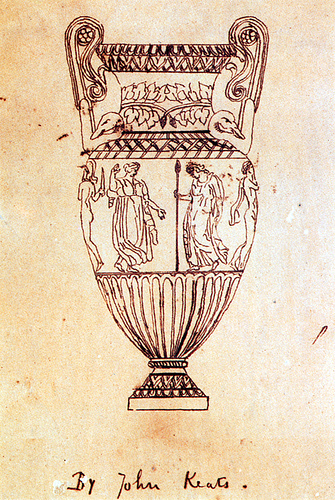
Tracing of an engraving of the Sosibios vase by Keats (Wiki)
The Complexity of The Critique of Judgment and its Power to Generate Inquiry
However, it is important to note that Kant’s Critique of Judgment is a very difficult book full of dense, suggestive, and even unclear passages that result in very different interpretations that allow us to address the above questions and objections in very different ways. Let me briefly explore one example that gives us another way to understand the inexhaustibility of English garden-like forms.
It is true that Kant emphasizes form and is often seen as the founder of formalism in aesthetics. This might lead us to think he is reducing beauty to mere structural or geometrical properties. But in section 49 he claims that fine art has “spirit” or “that which puts the mental powers purposively into swing, i.e. into such a play as maintains itself and strengthens the powers in their exercise.” This spirit requires “aesthetic ideas” or representations of the imagination that occasion much thinking “though without it being possible for any determinate thought, i.e., concept, to be adequate to it” (section 49). He elaborates with reference to a line of poetry: “Thus, for example, a certain poet [Johann Philipp Lorenz Withof (1725–1789)] says, in his description of a beautiful morning:
“The sun arose
As calm from virtue springs.”
The consciousness of virtue, even if one only places oneself in thought in the position of a virtuous man, diffuses in the mind a multitude of sublime and restful feelings and a boundless prospect of a joyful future, to which no expression measured by a definite concept completely attains.” He also offers two visual examples: “Thus Jupiter’s eagle with the lightning in its claws is an attribute of the mighty king of heaven, as the peacock is of its magnificent queen. They do not, like logical attributes, represent what lies in our concepts of the sublimity and majesty of creation, but something different, which gives occasion to the Imagination to spread itself over a number of kindred representations, that arouse more thought than can be expressed in a concept determined by words.”
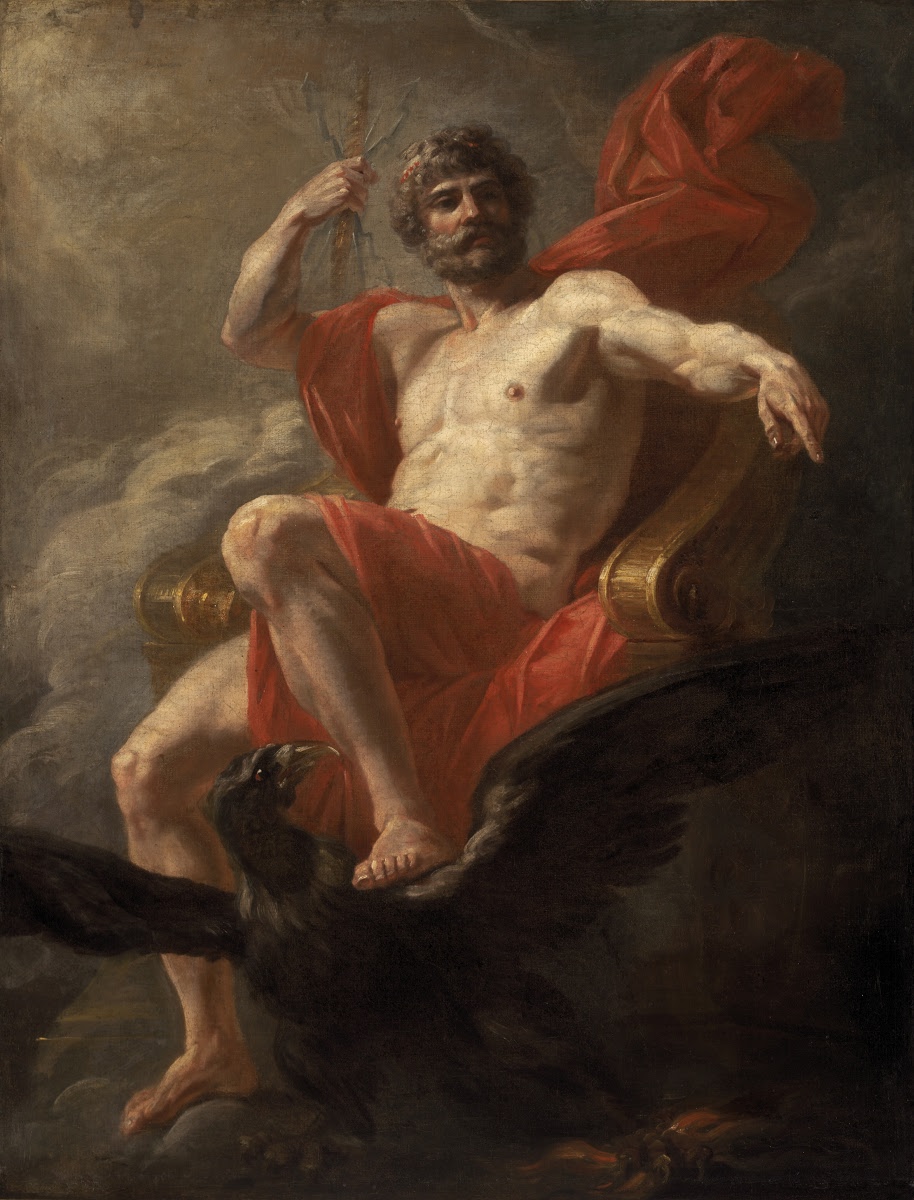
Heinrich Friedrich Füger, Jupiter Enthroned (1776-1818)
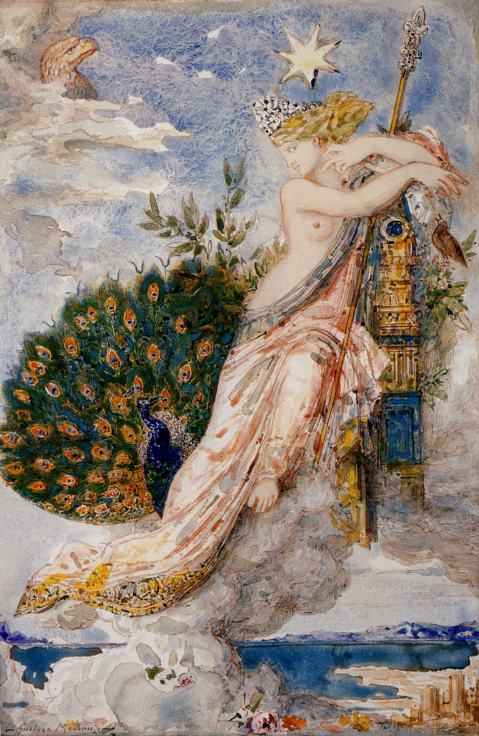
Gustave Moreau, The Peacock Complaining to Juno (1881) Do these images generate aesthetic ideas which generate more thought than can be expressed by a determinate concept?
I think Kant’s aesthetic ideas, since they generate thought without ever landing on a determinate concept or linguistic expression, are another way to account for the inexhaustible nature of beautiful art. And they help us see how this inexhaustibility is not a matter of sense perception and feelings alone: it is about thinking and ideas as well.
But how can formal structures adequately account for aesthetic ideas? Wouldn’t semantic meaning have to be involved as well? And wouldn’t form be a means to the expression of such ideas rather than being an end in itself? Later in the the work (section 60) Kant argues that our faculty of taste is ultimately a faculty for providing a sensible illustration of moral ideas that can help prepare us for the life of moral duty:
“Now taste is at bottom a faculty for judging of the sensible illustration of moral Ideas (by means of a certain analogy involved in our reflection upon both these); and it is from this faculty also and from the greater susceptibility grounded thereon for the feeling arising from the latter (called moral feeling), that the pleasure is derived which taste regards as valid for mankind in general and not merely for the private feeling of each. Hence it appears plain that the true propaedeutic [preliminary instruction or preparatory study] for the foundation of taste is the development of moral Ideas and the culture of the moral feeling; because it is only when sensibility is brought into agreement with this that genuine taste can assume a definite invariable form.”
If this is the case then it is hard to see how Kant is some arch formalist who advocates an autonomy of aesthetics with no moral dimension. In fact, it would seem aesthetic judgment has no autonomy at all since, as we just saw, “the foundation of taste is the development of moral Ideas and the culture of the moral feeling.”
Is all this a problem for him? Maybe not if we expand our conception of form past geometry to include, as he himself suggests, the aesthetic ideas expressed by such form. For then moral ideas could be part of the experience of the work. It might seem that moral ideas would be inconsistent with adopting a disinterested attitude. But I think we can contemplate moral ideas in a disinterested manner if (1) our purpose is not to engage in moral evaluation and/or action and (2) we experience these moral aspects in and through the work itself in a way that is primarily felt. For example, we might consider the forms involved in Van Gogh Shoes as expressing an aesthetic idea of moral fortitude that needs unravelling. Martin Heidegger, in his essay “The Origin of the Work of Art,” wrote:
“From the dark opening of the worn insides of the shoes the toilsome tread of the worker stares forth. In the stiffly rugged heaviness of the shoes there is the accumulated tenacity of her slow trudge through the far-spreading and ever-uniform furrows of the field swept by a raw wind. On the leather lie the dampness and richness of the soil. Under the soles slides the loneliness of the field-path as evening falls. In the shoes vibrates the silent call of the earth, its quiet gift of the ripening grain and its unexplained self-refusal in the fallow desolation of the wintry field. This equipment is pervaded by uncomplaining anxiety as to the certainty of bread, the wordless joy of having once more withstood want, the trembling before the impending childbed and shivering at the surrounding menace of death.”
Heidegger’s interpretation of Van Gogh’s 1886 version of Shoes is contested which is fine: aesthetic ideas are not determinate and open a space for various interpretations. The key is that the moral dimensions of his reading can be contemplated in and through the work itself unlike, say, thinking about this iconic photo which typically leads us to morally evaluate certain troubling facts beyond it, namely, the plight of actual farmers in the Dust Bowl during the Great Depression:

Dorothea Lange, Destitute pea pickers in California. Mother of seven children. Age thirty-two. Nipomo, California (1936)
So that is just one example of how Critique of Judgment gives rise to both a strict formalist interpretation and provides the means to contest that very interpretation. And we can raise plenty of other examples that show how Kant avoids the trap of easy definition on subjects such as the objectivity of beauty, disinterested judgment, and the nature of the common sense. As a result, I think there are plenty of ways the above questions can be plausibly addressed using Kantian resources. We can miss these resources if we oversimplify Kant’s text and dogmatically adopt interpretations rather than seeing them as a means to further inquiry. Indeed, in keeping with the foregoing, I think Critique of Judgment is itself an inexhaustibly rich work to which we can always return! As an aid to further inquiry, go here for an in-depth overview of Kantian aesthetics, its many controversies, and the diverse range of scholarly positions on those controversies.
Conclusion
I think the term ‘beauty’ can denote a set of family resemblances each of which has something important to offer. As we’ve seen, in section 16 Kant himself distinguishes between “free beauties,” which do not presuppose a concept, and “dependent beauties,” which do. For example, he notes that “the beauty of a horse…presupposes a concept of the purpose which determines what the thing is to be, and consequently a concept of its perfection; it is therefore dependent beauty.”
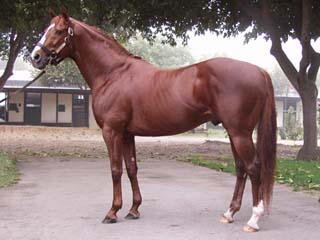
A thoroughbred certainly is a dependent beauty if evaluated in accordance with its internal perfection and external use value. But Kant admits a judgment of pure beauty regarding a horse would be possible “if either the person judging has no concept of this purpose, or else abstracts from it in his judgement.” Perhaps a painting which represents such a horse would assist in such abstraction:
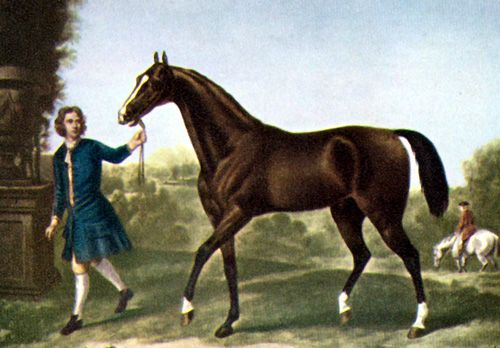
The Darley Arabian Thoroughbred
So Kant himself can be employed to explore more than one form of beauty and his distinction can even resolve disputes as he points out:
“Such a person, although forming an accurate judgement of taste in judging of the object as free beauty, would yet by another who considers the beauty in it only as a dependent attribute (who looks to the purpose of the object) be blamed, and accused of false taste; although both are right in their own way, the one in reference to what he has before his eyes, the other in reference to what he has in his thought. By means of this distinction we can settle many disputes about beauty between judges of taste; by showing that the one is speaking of free, the other of dependent, beauty,—that the first is making a pure, the second an applied, judgement of taste.”
Perhaps adding even more accounts of beauty would help us work through other disputes as well and see how people can, given their different theoretical approaches to aesthetics (e.g, expression theory, aesthetic cognitivism or instrumentalism, and imitation for example), be “right in their own way.”
In any case, one thing is clear to me: Kant’s rather extreme account can, with some adjustments and developments, be convincing as one form a judgment of beauty can take. And I think it is an incredibly important form. For according to it, when we are in the presence of beauty it is as if we are wandering in an English garden or a bounded composition of diverse and irregular factors presented with a degree of supporting, rather than overpowering, order always new to our imagination. And this makes us always new as well by enhancing our freedom in at least four ways:
(1) If judgments of the beautiful are disinterested then we are free from linking our imagination to judgments about what is useful, true, and good. The imagination is free to play and take pleasure in the forms of things for their own sake.
(2) If judgments of the beautiful are grounded in our common sense then they are grounded in a set of capacities, perhaps even a “supersensible substrate,” shared by all humans. These shared capacities allow us to be free from our idiosyncratic, ego-based, and often self-interested perspectives. They may also give us the freedom to pursue the metaphysical and even religious implications of this freedom.
(3) When we encounter beauty we experience a free play of the imagination in which alternatives are played with, explored, and discussed. Thus we are free to consider alternatives and see the world in very different ways.
(4) And when we encounter beauty we feel as if our understanding and imagination, in being stirred by properties in the environment, are somehow in harmony with them. According to Kant, we can’t prove nature is teleologically structured, that is, structured in accordance with goals (telos = goal in Greek), which harmonize with our faculties. But he argues that the experience of beauty makes it sensible to suppose it is and to use that supposition as a regulative ideal to guide our efforts to understand the world. Thus in beauty we feel at home and are free from the view that we don’t fit into a world where nothing makes sense.
But we must remember that, despite all these philosophical insights, gardens of beauty will always remain partially wild according to Kant. We can invite people to walk with us, we can share their beauty through direct experience, and we can philosophize and debate about them. But our lack of determinate concepts ensures we will never put them in a definitive conceptual box. And the disinterestedness requirement ensures their beauty will remain hidden should we seek to use, manipulate, and exploit them for our selfish ends. The experience of beauty is thus a sacred path upon which we attend to, and care for, singular things for their own sake – something to be welcomed given widespread narcissism and the terrifying psychological, sociological, and ecological results of unchecked use-value and mass production in the world. This is not a path for distracted travelers for whom one thing is a means to another and that thing to yet another ad infinitum. Rather, it is a path of contemplative attention that yields delightful fulfillments – potentially shared delightful fulfillments for Kant given our shared human nature – of the “unstudied and final play” of our imagination. In this revitalizing space of play we feel at home, reduce our alienation from each other and nature, and realize that life is worth living.

Pierre-Auguste Renoir, Femmes Dans Un Jardin (1873)
© Dwight Goodyear 2026
Read Kant’s Critique of Judgment here.
For my many posts on aesthetics, go here.
For my post on Plato’s vision of beauty in relation to the soul, virtue, and love, a vision that appears to include a notion of disinterestedness but under a different description, go here.
For my other posts on beauty-related content, go here.
For my Kant-related posts, including my extensive overview of his theory of the sublime, go here.
For an interesting School of Life video on English and French gardens and how we can think about them metaphorically, go here.
For Roger Scruton’s BBC film Why Beauty Matters, which, among other things, accepts Kant’s account of disinterestedness and explores how it can have important psychological, social, and religious consequences, go here.
For a view quite different from Scruton’s, read George Dickie’s “The Myth of the Aesthetic Attitude” here.