258. Kant on Forms of Beauty as English Gardens
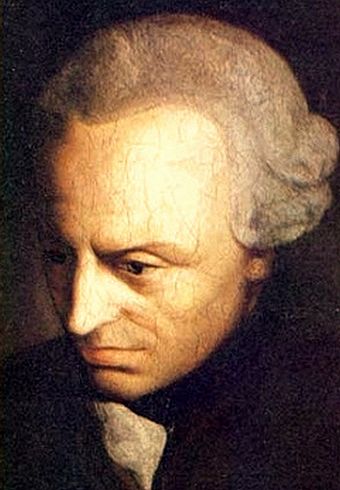
Immanuel Kant (1724-1804)
Introduction
There are two common positions when it comes to judgments of beauty. On the one hand, many think that beauty is “in the eye of the beholder”: a matter of opinion with no objective reference whatsoever. On the other hand, some think beauty is an objective property of things that exist independent of beholders. However, the philosopher Immanuel Kant offers us a third option in his influential book on aesthetics Critique of judgment (1790). Kant claims judgments of beauty are aesthetic which means they are judgments about the pleasure we feel in relation to certain things. This means, of course, that beauty is indeed in the eye of the beholder and is not an objective property of things. However, to this subjective side he adds certain objective conditions that trigger our faculty of taste, or our capacity to judge beauty, to feel this pleasure. Thus for him judgments of beauty are the outcome of both subjective and objective factors.
In this post I want to explore this alternative which, once understood, opens up the surprising possibility that beauty can be a matter of subjective feelings which are nonetheless universal. I also want to explore in some detail one of the objective conditions Kant briefly mentions, namely, that forms of beauty must be inexhaustibly interesting and always new to us. Such forms, he suggests, are akin to an English garden whose minimal imposition of order supports, rather than removes, the wild richness of nature. What is so intriguing about this condition is that offers a criterion for understanding beauty which, rather than reducing beauty to a determinate concept or rule, allows for a potentially infinite diversity of forms. And it offers us an inspiring vision of beauty as a force of vitality and renewal that has profound implications for our lives. Let’s begin with a look at the subjective side of things when a judgment of beauty is made.
The Subjective Side
When Kant describes judgments of beauty from the subjective side of the experience, he offers three necessary conditions.
(1) Judgments of the beautiful must be disinterested (see Division 1, Book 1, sections 1-5)
This means that, while we do experience pleasurable feelings in making a judgment that something is beautiful, this pleasure is neither the outcome of, nor gives rise to, a desire for the thing. When we make an interested judgment, we desire something because it is useful, morally good, or true. But in a disinterested judgment these desires disappear and we give our full attention to something’s form for its own sake. One way to think about this is to say we do not judge x to be beautiful because it pleases our desires (as we might when we see a table full of tasty food) but rather it pleases us because we judge it to be beautiful (as we might when we see a still life painting of a table full of tasty food).

Jan van Kessel, Still-Life on a Table with Fruit and Flowers
(2) Judgments of the beautiful must be universal (see Division 1, Book 1, sections 6-9)
When we judge something to be beautiful we don’t think our judgment is only a matter of subjective feelings. No, we place the beautiful thing on a pedestal and try to convince others that they should feel the same. Thus if we judge something to be beautiful we think it should judged universally so: beautiful for everyone, everywhere, at all times. If one doesn’t think this then one is not, for Kant, making a judgment of the beautiful but a judgment about what is, as he says, “personally agreeable.” It is important to note that Kant is not saying people do, in fact, agree about what is beautiful. He is only saying that judgments of the beautiful entail the belief that others should feel as we do.

I took this photo of the Austrian Alps which struck me as beautiful. There I think you should judge it to be beautiful as well!
(3) Judgments of the beautiful must be held to be a necessary judgment (see Division 1, Book 1, sections 18-22)
But how can we expect that the things we take to be beautiful will necessitate others to feel the same way? Kant thinks we presuppose this necessity when we rigorously debate about what is and what isn’t beautiful – a plausible view to hold. But what can make sense of this necessity if aesthetic judgments are about our feelings which, so it seems, are idiosyncratic and therefore relative to individuals? Well, in his Critique of Pure Reason he argues that our minds are not passive receivers of sense data but actively structure incoming data to make our experience what it is. For example, he argues that all humans experience the world as a system of cause and effect relations because our mind structures the events of our experience as causal ones. That which actively shapes sense data are “the categories of the understanding.” In his Critique of Judgment the “common sense” (sensus communis) plays a similar role in aesthetics. It is a capacity of the mind that allows us to judge by feeling rather than concepts (obviously to be differentiated from the everyday meaning of the word). And in the presence of certain kinds of forms this capacity will resonate the same way if we adopt a disinterested attitude. Thus it is by virtue of the common sense that we can expect others to necessarily agree with our judgments of the beautiful. And Kant says this necessity, rather than being a function of rules or concepts as in logic or science, is “exemplary”: our judgments of beauty themselves exemplify it in their claims to universal validity.

Caspar David Friedrich, Two Men Contemplating the Moon (ca. 1825-30): A shared perception of beauty made possible by our common sense?
The Objective Side
But what kinds of forms will our common sense resonate with and give us a feeling of pleasure? This leads to the fourth aspect of Kant’s analysis of judgments of beauty:
(4) Judgments of the beautiful must be in response to something that has the form of purposiveness without the presentation of a definite purpose (see Division 1, Book 1, sections 10-17)
Typically an object is understood to have a purpose if it is made according to some conception of a definite external end. For example, a car is constructed according to certain concepts, some of which include the ability to get people somewhere, protect them in certain ways, give them pleasure, and so on. But we can also think of a definite purpose internal to something such as the purpose of an acorn to become an oak. But according to Kant, when we perceive something as beautiful we do not do so with these definite external or internal purposes in mind. Rather, we discover that the thing is purposive but has no definite purpose. Take, for example, the act of looking at a beautiful painting. We may find our eyes following the lines, tracking the dynamic colors, and discovering relationships. Alternatives are played with, ideas are explored, and interpretations considered. We dwell on what fits or doesn’t fit, what works, what is interesting, and so on. Kant refers to this aesthetic engagement as a “free play of the imagination” in which the aspects of the painting are imaginatively considered in relation to one another in a way that is profoundly purposive but in an open, searching, and non-definite manner.
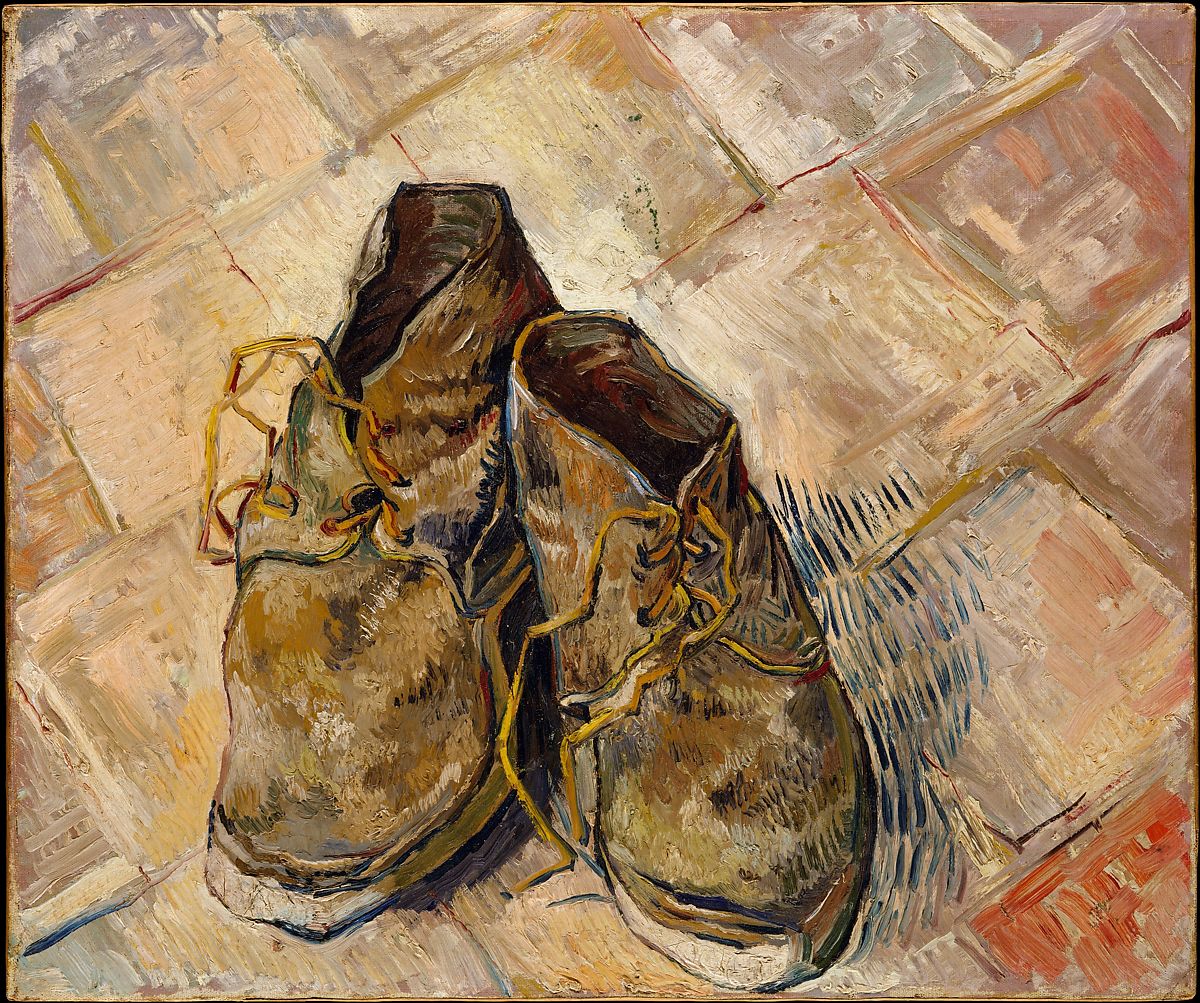
Van Gogh’s Shoes (1888). We are not thinking of shoes to be used nor are we seeing them as specimens of perfectly actualized form! And yet the shoes trigger a free play of the imagination that is purposive but in an indefinite way.
Kant offers a few helpful clarifications of this rather vague notion. For example, he says beautiful forms are bounded unlike those of the sublime marked by boundlessness. But the clarification I find most helpful and interesting is this: they must always appear new and inexhaustible to us. There is an eternal freshness and a vitality in beautiful things that allow us to return to them over and over again. Consider this passage from the Critique of Judgment (see the section “General Comment of the First Division of the Analytic”) which makes an interesting reference to English gardens:
“With a thing that owes its possibility to a purpose, a building, or even an animal, its regularity, which consists in symmetry, must express the unity of the intuition accompanying the concept of its end, and belongs with it to cognition. But where all that is intended is the maintenance of a free play of the powers of representation (subject, however, to the condition that there is to be nothing for understanding to take exception to), in ornamental gardens, in the decoration of rooms, in all kinds of furniture that shows good taste, etc., regularity in the shape of constraint is to be avoided as far as possible. Thus English taste in gardens, and fantastic taste in furniture, push the freedom of imagination to the verge of what is grotesque the idea being that in this divorce from all constraint of rules the precise instance is being afforded where taste can exhibit its perfection in projects of the imagination to the fullest extent. All stiff regularity (such as borders on mathematical regularity) is inherently repugnant to taste, in that the contemplation of it affords us no lasting entertainment. Indeed, where it has neither cognition nor some definite practical end expressly in view, we get heartily tired of it. On the other hand, anything that gives the imagination scope for unstudied and final play is always fresh to us. We do not grow to hate the very sight of it. Marsden, in his description of Sumatra, observes that the free beauties of nature so surround the beholder on all sides that they cease to have much attraction for him. On the other hand he found a pepper garden full of charm, on coming across it in mid–forest with its rows of parallel stakes on which the plant twines itself. From all this he infers that wild, and in its appearance quite irregular beauty, is only pleasing as a change to one whose eyes have become surfeited with regular beauty. But he need only have made the experiment of passing one day in his pepper garden to realize that once the regularity has enabled the understanding to put itself in accord with the order that is the constant requirement, instead of the object diverting him any longer, it imposes an irksome constraint upon the imagination: whereas nature subject to no constraint of artificial rules, and lavish, as it there is, in its luxuriant variety can supply constant food for his taste.”

Beautiful things can be new to us because they are not formulaic, derivative, and predictable as so many works with made with prefixed concepts, regular patterns, ratios, and so on are. As he said above, “regularity in the shape of constraint is to be avoided as far as possible.” True, we don’t want excessive irregularity either so that, as Kant says, we end up with something “grotesque.” But irregularities integrated to the verge of excess can offer an occasion for “taste can exhibit its perfection in projects of the imagination to the fullest extent.” Some think Kant was condemning English gardens as excessive in the above passage which I don’t think is the case. I think he was pointing to a limit case consistent with his views on beauty. But whatever his thoughts on the matter, I think plenty of English gardens offer a mean between excessive regularity and excessive irregularity which nicely illustrate his point.
Whether French gardens can achieve this balance is unclear. Here I think of my trip to the gardens of Versailles in France where I encountered some very impressive feats of symmetry indeed:
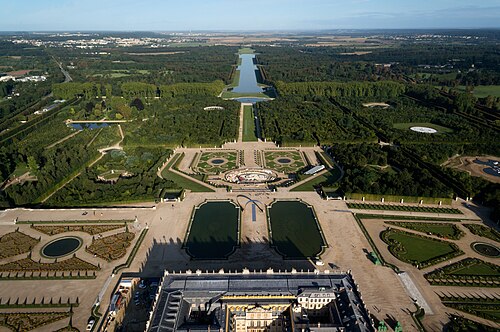
Jardins du château de Versailles (photo by ToucanWings)
Here is the plan of the gardens from 1746 which shows the rigorous geometry involved:
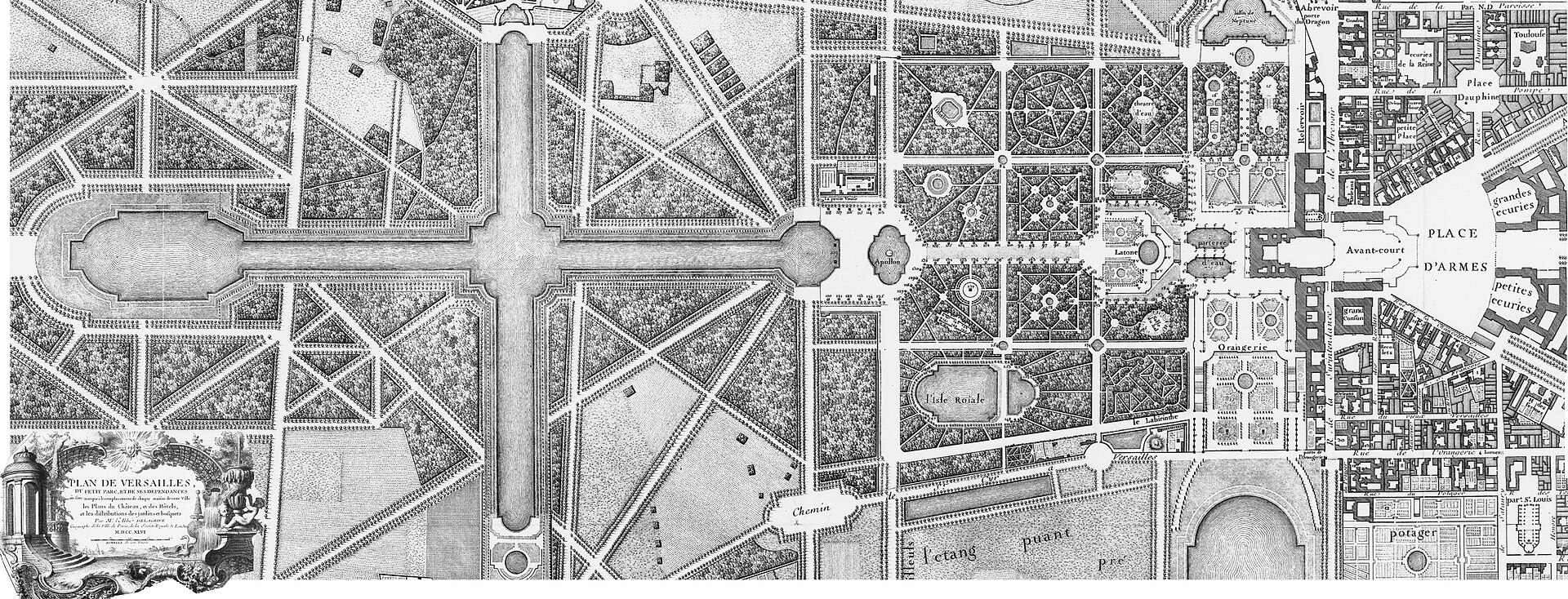
Naturally these highly structured gardens are incredible. But I’m not so sure they would always be new to me. On the other hand, I’m more confident that an English garden could avoid predictability not by presenting something completely wild but by imposing just enough order to allow the rich diversity of nature to present itself in ways that are not overwhelming. Wouldn’t a stroll down this path activate our common sense and generate a vitalizing free play of the imagination every time?
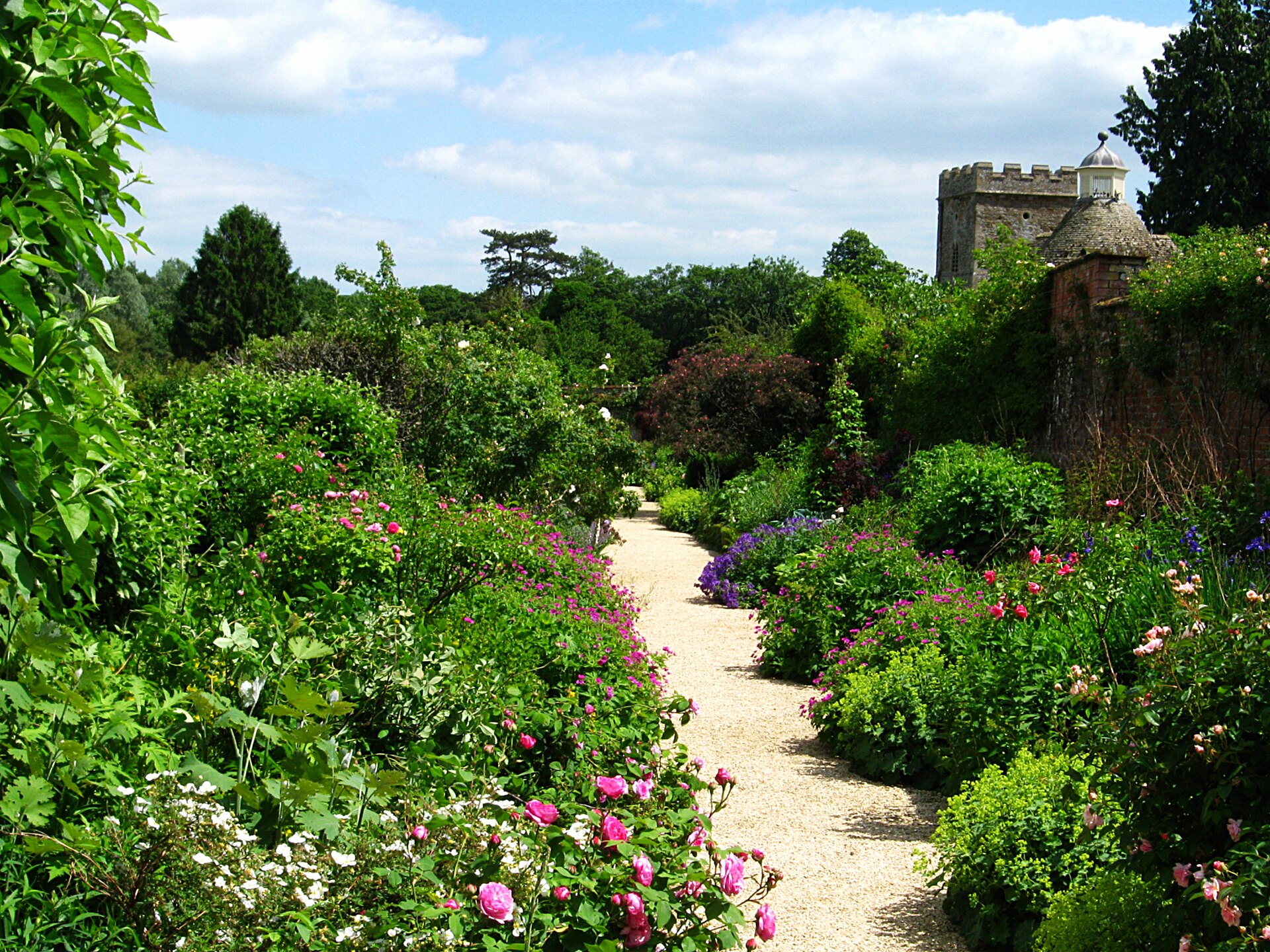
Rousham House Gardens in Oxfordshire (photo by Jason Ballard)
I certainly felt like the English Garden in Munich, Germany could sustain my interest forever as I strolled through it this past summer:

The Englischer Garten in Munich, Germany (photo by Dwight Goodyear). Creation of the park began in 1789. The waterfall was created in 1815.
Japanese gardens employ a similar approach of imposing only enough order to allow nature to appear in its rich diversity and asymmetry. For example:
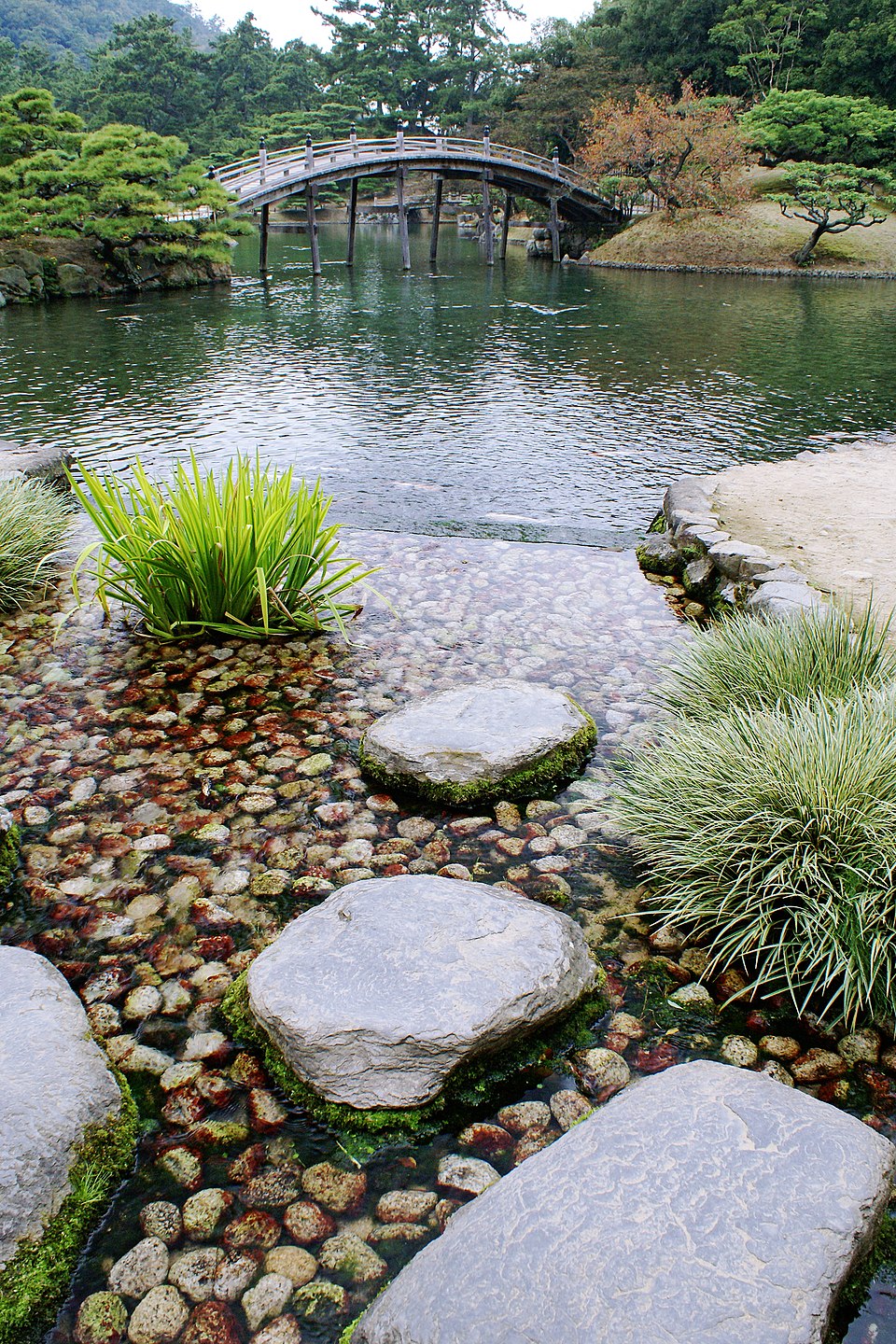
Ritsurin Garden in Takamatsu, Kagawa Prefecture, Japan (Photo by 663highland)


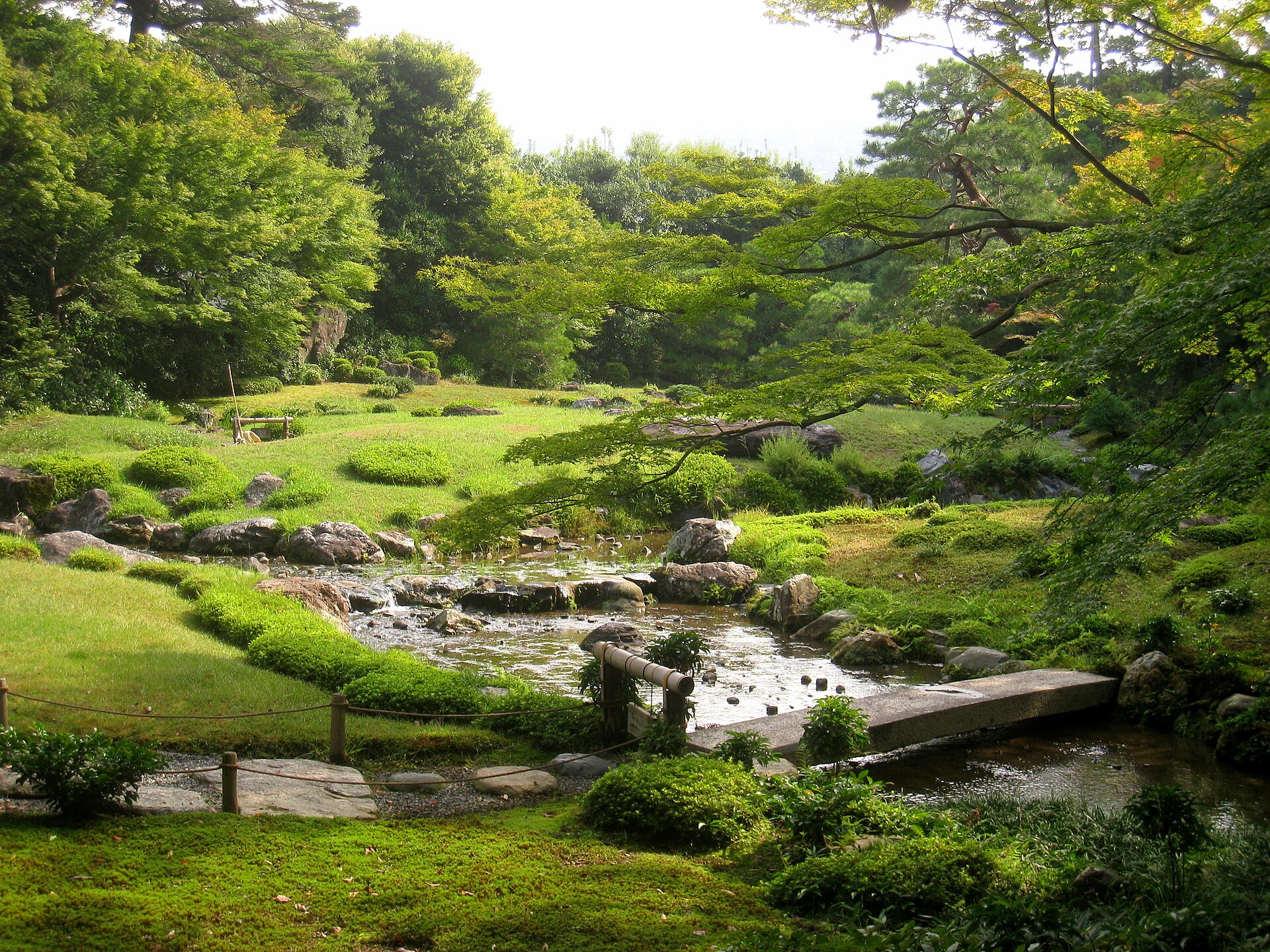
Murin-an, 8 Nanzenji-kusakawa-cho, Sakyo-ku, Kyoto, Japan (photo by Daderot)
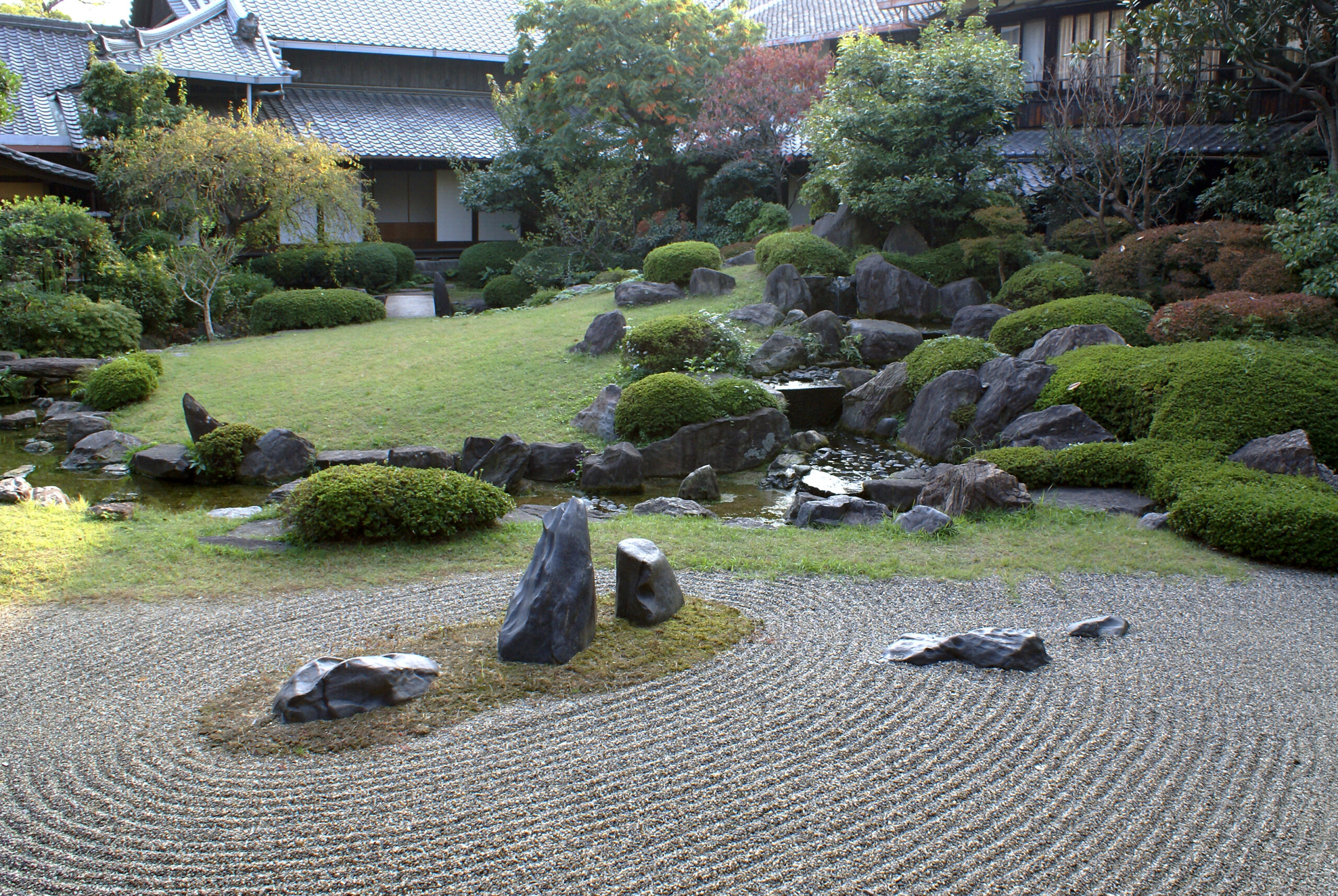
Shitennō-ji Honbo Garden in Osaka, Osaka prefecture, Japan (photo by 663highland)
Forms of Beauty as English Gardens
But I don’t think Kant’s insight relies on rigid definition of gardens which are, after all, incredibly diverse and have been categorized in complex ways. His point, as I take it, is that the formal conditions that stimulate a free play of the imagination will, like a well-crafted English garden, have a rich diversity of irregular factors presented with a degree of supporting, rather than overpowering, order. I think this condition helps explain why we take beautiful things to be inherently valuable: the richness of their forms warrants endless attention.

Painting of an English garden’s elements by Johann Rombauer (1803)
And it is a condition which can be met by things very different from actual gardens. For example, I find this glass cube by Larry Bell which, as he says, “reflects, absorbs, and transmits light at the same time,” to be a trigger for the feeling of beauty in me. Bell is sometimes referred to as a minimalist and that can be true given the minimal materials involved. But the effects that flow from the materials, which are ever changing and unique to every person who encounters them, are rich indeed as you can imagine from this example:

Larry Bell, Untitled Cube (1993)
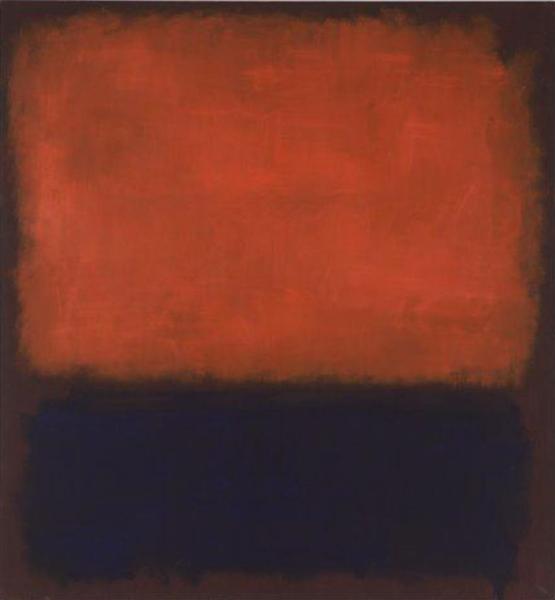
Many of Rothko’s works, such as painting No. 14 from 1960 with its throbbing color field of full of nuances, comes to mind as well:
And Pollock’s Autumn Rhythm has a specific color palette and rhythm that brings its wild energy into a bounded whole in which our imagination can freely play:

Jackson Pollock, Autumn Rhythm (Number 30), 1950
Of course, we need to keep in mind that, according to Kant, these conditions on the objective side of judgments of beauty – being a bounded whole that is indefinitely purposive, appreciated for its own sake, and inexhaustible – are not, despite our common way of speaking, objective properties of beautiful things outside us. Moreover, they are “determinate concepts” which, like the golden ratio for example, would set universal rules for beauty and enable us to judge something as beautiful or not without even experiencing it. Kant says aesthetic judgments are not “determine judgments” in which we start with a clear concept of something and judge a particular thing to fall under that concept (as we do when we judge a particular shape to be a triangle). Rather, they are “reflective judgments” in which we start with a particular thing and then try and find a concept for it. Perhaps the conditions we have discussed are the fruits of this search which, while providing some understanding, fall short of being determinate.
Questions
Kant’s account, in bringing together both subjective and objective factors in a way that does justice to our feelings without losing the universality commonly associated with reason, is certainly as impressive as it is influential. It also raises some questions. Perhaps the most important is this: should judgments of the beautiful arise only in response to the formal properties of a thing? You may like the color green and I may not like it; you may like the sound of cellos and I may not like it. But for Kant, colors and sounds will not be what we are reacting to in our judgments of the beautiful; we will only be reacting to the formal properties of a painting or a piece of music: the shapes, the structures, the proportions, the ratios, etc. This seems far too limited for some. Shouldn’t beauty also be understood with reference to content? Think of someone you take to be beautiful. Isn’t part of his or her beauty a matter of content and not just form?
Moreover, Kant, as we have seen, did not think judgments of beauty could be determinate judgments that place a particular thing under a universal concept or rule. But many claim we do have determinate concepts of beauty such as the golden ratio. Two quantities are in the golden ratio if the ratio between the sum of those quantities and the larger one is the same as the ratio between the larger one and the smaller: 1:1.618 (1:1.6180339887…). Some argue that faces that closely approximate the ratio will be considered beautiful by everyone despite, for example, their tastes in hair, skin, or eye color. So can there be determinate concepts of beauty after all?
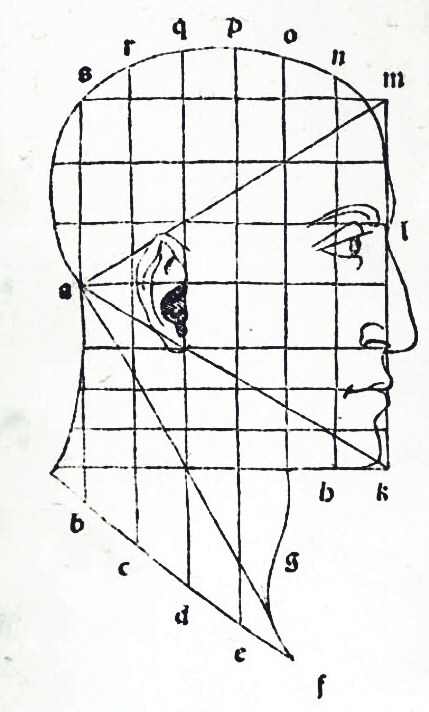
Leonardo da Vinci’s illustration of a human head. The Golden Ratio (approximately 1:1.618) is often held to be an objective measure of beauty. Kant would disagree!
Are we really prepared to accept only objective conditions that trigger the experience of beauty? What not believe that certain people, places, and things actually have beautiful properties? We can appreciate Kant’s effort to incorporate aspects of subjectivity and objectivity in his account. But why place beauty proper inside the subject as a feeling only? Why not include some aspect of real beauty on the objective side as well?
Is it really true that judgments of beauty must be universal? Is there a way to preserve a degree of objectivity without having to commit to universality? And if we require a common sense or shared faculty of human nature to make sense of this universality then isn’t that a problem given the sheer diversity, disagreement, and situational differences we see in the world? it certainly seems so as Richard J. Bernstein, in his book Beyond Objectivism and Relativism (University of Pennsylvania Press, 1983), points out:
“Once we begin to question whether there is a common faculty of taste (a sensus communis), we are easily led down the path to relativism. And this is what did happen after Kant—so much so that today it is extraordinarily difficult to retrieve any idea of taste or aesthetic judgment that is more than the expression of personal preferences. Ironically (given Kant’s intentions), the same tendency has worked itself out with a vengeance with regards to all judgments of value, including moral judgments” (120).
Finally, we can certainly question his criterion of disinterestedness. Can’t beauty be understood, at least sometimes, in relation to something exercising a function? Can’t it be understood in relation to moral qualities as when we see the beauty of someone’s virtuous character? And isn’t it the case that, as Plato appears to have thought, our encounter with beauty can also be an encounter with truth? Ian Stewart, in his book Why Beauty is Truth: A History of Symmetry (Basic Books, 2007), asserts that “In Mathematics, beauty must be true—because anything false is ugly” (280). But if this is the case then perhaps beauty is about cognition as well as feeling. Those committed to the project of aesthetic cognitivism maintain just this.
Conclusion
These are just some of the questions that can be raised and many of them can receive plausible, perhaps even convincing, responses from defenders of Kant (for an in-depth overview of Kantian aesthetics and the scholarship involved go here). But I prefer to avoid either completely rejecting or completely embracing his theory. I think the term ‘beauty’ can be a term that denotes a set of family resemblances each of which has something important and unique about them (Kant himself distinguishes between free and dependent beauties). Seen this way, Kant’s account can be, perhaps with some adjustments here and there, convincing as one form a judgment of beauty can take in our experience.
And I do think it is an incredibly important one which offers us a vision of contemplative beauty that includes singularity, uniqueness, diversity, and mystery – things which, however elusive, can serve as revitalizing antidotes to all the predictable, derivative, and boring things in the world. For Kant, whenever we are in the presence of beauty it is as if we are wandering in an English garden where, because everything is new to us, we are new as well as we consider alternatives, encounter unexpected relationships, and forge connections. We can invite people to walk with us, we can share this beauty through experience, and we can even philosophize about it. But we cannot put it in any definitive conceptual box: it will always remain free of our restricting rules. And it will always remain untouched by our desires to use, manipulate, and exploit it for our selfish ends. The experience of beauty is thus a sacred path upon which we attend to, and care for, things for their own sake. This is not a path for distracted travelers for whom one thing is a means to another and that thing to yet another ad infinitum. Rather, it is a path of delightful fulfillments – shared delightful fulfillments for Kant given our shared human nature – of the “unstudied and final play” of our imagination. In this space of play we feel at home, reduce our alienation from each other and nature, and realize that life is worth living.

Pierre-Auguste Renoir, Femmes Dans Un Jardin (1873)
For my many posts on aesthetics, go here.
For my posts on beauty-related content, go here.
For my Kant-related posts, including my overview of his theory of the sublime, go here.